
grains are ground into flour at gristmills
Source: Library of Congress, Old gristmill on road to Skyline Drive, Virginia (by Lee Russell, 1938)
grains are ground into flour at gristmills
Source: Library of Congress, Old gristmill on road to Skyline Drive, Virginia (by Lee Russell, 1938)
Grains and nuts are ground into flour before cooking/baking into food. For nearly six centuries before the English colonists reached Virginia, Native Americans pounded dry corn kernels into meal for cooking in stews or heating on stones to make bread. Mortars and pestles were made from stone or wood.
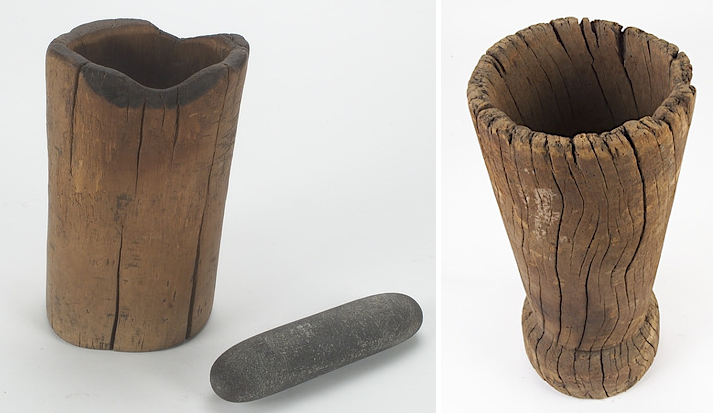
Native Americans and early colonists ground grains and nuts into flour with wood mortars and stone (or wood) pestles
Source: National Museum of the American Indian, Mortar and pestle; corn mortar
European colonists used the same approach to process small batches of grain. The hand mill was called a "quern." 1
They also brought a technology to create flour and meal on a larger scale. For 400 years, corn and wheat seeds (mostly starch, but with gluten-rich proteins) have been processed at mills all across Virginia for making bread and other baked goods. Grindstones in those mills were moved primarily by wind and water until the development of diesel engines and electricity.
A report of a visitor to Virginia in 1647 included:2
Today, stone millwheels are primarily decorative items. A few still-operating mills require millers to "keep their nose to the grindstone" to check the quality of the flour.

almost all gristmills in Virginia were powered by water until diesel engines became readily available
Source: Library of Congress, Detail of gristmill on way to Skyline Drive, Virginia (by Lee Russell, 1938)

wheat grains or corn kernels dropped from a square hopper and ended up between the circular grindstones, before emerging as flour/cornmeal
Source: Library of Congress, Old gristmill hopper, on way to Skyline Drive, Virginia (by Lee Russell, 1938)
Mills were centers of community as well as industrial operations. Small mills ground wheat and other grains for local farmers, who often took home the flour from their own crop (minus the portion of "toll" paid to the miller). Merchant mills paid cash for wheat, then sold the flour separately to customers who had not brought their own grain for processing.

soon after the end of the Revolutionary War, Nathaniel Burwell and Daniel Morgan built a merchant mill in what became known as Millwood to grind grain produced by local wheat farmers
Source: Library of Congress, Burwell Mill, State Route 723, Millwood, Clarke County, VA

key parts within the mills were constructed from locally-available timber

wheel axle with wooden gear teeth
Thomas Jefferson built two flour mills on the Rivanna River, plus a separate sawmill complex. He reserved one of the flour mills to grind grain for his own use, and leased the second mill for commercial use to grind grain for others. The stone walls of the large gristmill, constructed in 1807, is the most obvious evidence of the Shadwell plantation today.3
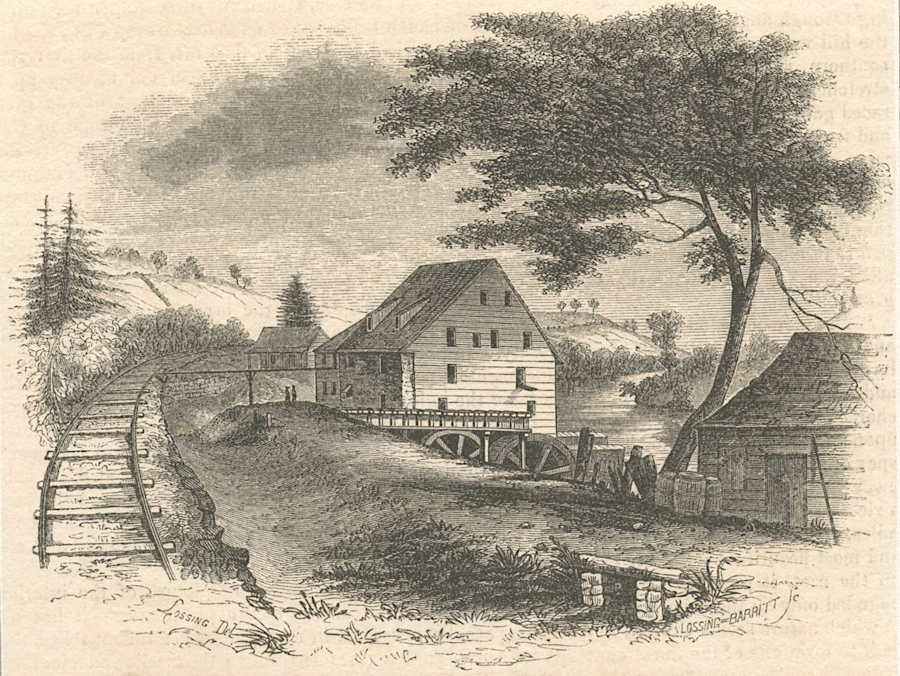
Thomas Jefferson built his large mill on the Rivanna River in 1807, before the railroad arrived
Source: New York Public Library, Jefferson's Mill at Shadwell
The Chapman/Beverly Mill in Thoroughfare Gap (on the border of Prince William and Fauquier counties) was expanded to 7 stories in 1758 to become one of the tallest stone structures in the United States. The expansion of the mill, almost 100 years after it was originally built, occurred after the Manassas Gap Railroad connected the mill directly to the port of Alexandria in 1752.
Source: Exploring History Together, A Walk Around the Beverley - Chapman Mill in Virginia
Source: Hill's Channel, Old Water Powered Mills of Floyd County, VA
Source: WSLS, End of an era: Big Spring Mill to close its doors

the Gallego Mill in Richmond
Source: University of North Carolina, The Great South; A Record of Journeys in Louisiana, Texas, the Indian Territory, Missouri, Arkansas, Mississippi, Alabama, Georgia, Florida, South Carolina, North Carolina, Kentucky, Tennessee, Virginia, West Virginia, and Maryland (1875)

the large flour mills in Richmond were destroyed in the April, 1865 Evacuation Fire
Source: National Archives, Ruins of Haxalls (or Gallego) mills, Richmond, Va. (Taken in April, 1865)

the Gallegos and Haxall mills in Richmond exported flour to South America, but were destroyed when Richmond burned at the end of the Civil War
Source: Library of Congress, Richmond, Va. View on James River and Kanawha Canal near the Haxall Flour Mills; ruins of the Gallego Mills beyond