Lead Mining at Austinville
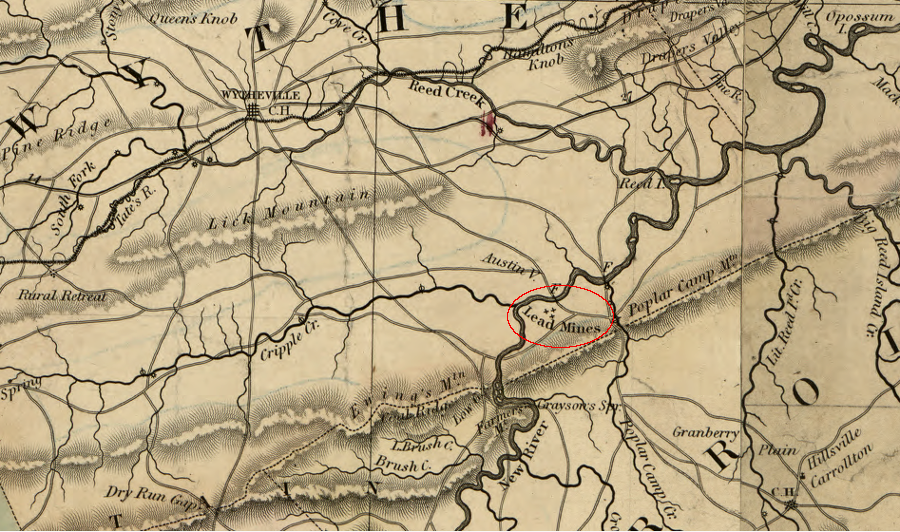
the lead mines on the New River in Wythe County were operated by Moses Austin, but he failed to generate a profit and moved to Missouri
Source: Library of Congress, A map of the state of Virginia, constructed in conformity to law from the late surveys authorized by the legislature and other original and authentic documents (1859)
John Chiswell discovered the lead deposits in what was then Augusta County in 1756, supposedly when hiding in a cave from Native Americans. Chiswell was running an iron furnace near Fredericksburg and recognized the value of the vein in the dolomite bedrock. The cave did not extend far into the cliff, so Chiswell had enough sunlight to recognize the vein.
In 1761 during the French and Indian War, William Byrd III led the 1st Virginia Regiment on a campaign against the Cherokee in Tennessee. In a very cautious march to the Long Island of the Holston River, Byrd built a number of forts to protect his supply line. He named the fort near the mines Forth Chiswell.
Chiswell developed the Lead Mine Company in 1761 with help from two wealthy and politically-influential investors, Colonel William Byrd III and John Robinson. Robinson was his son-in-law, but more importantly he had been serving as both Speaker of the House of Burgesses and Treasurer of the colony since 1738. Chiswell recruited Welsh miners and acquired 36 enslaved workers to develop the lead mines in 1764.
Chiswell never patented the land he was mining. There was no need to pay the costs of acquiring clear title and having to pay quitrents. With Robinson and Byrd as partners, the colony was not going to give anyone else the right to claim the property.1
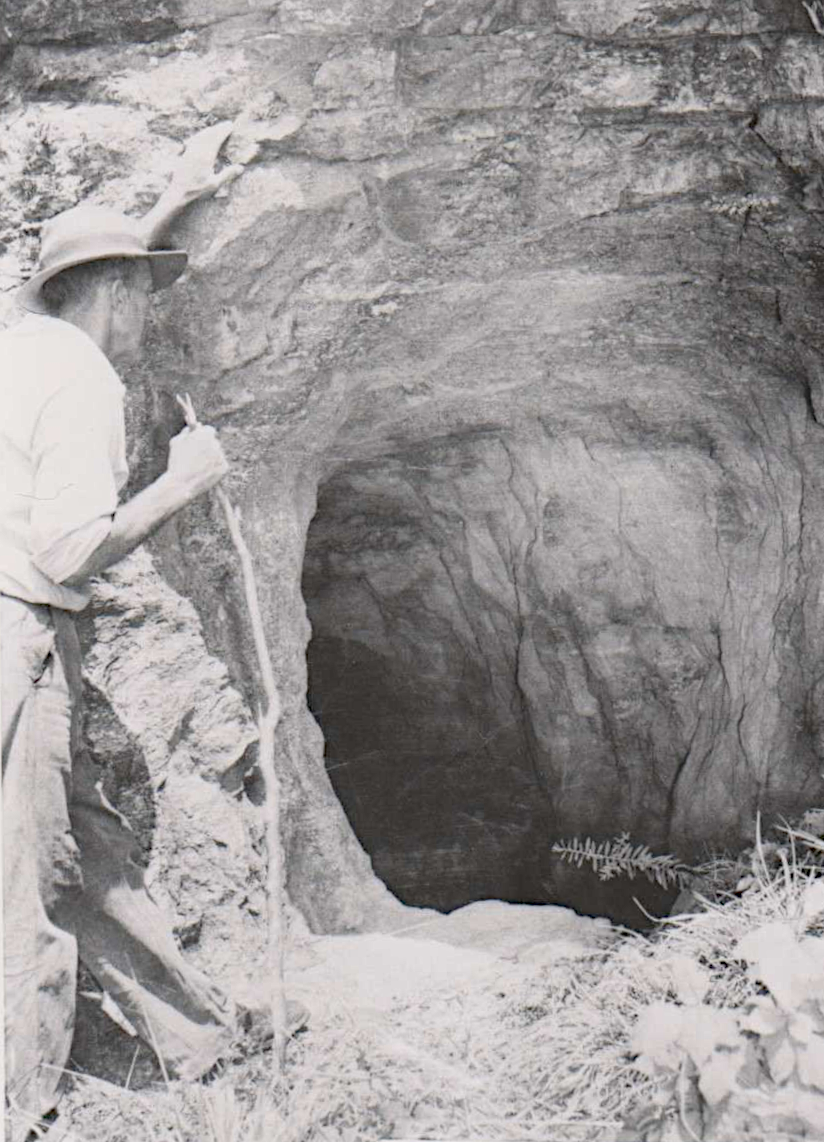
the original cave where John Chiswell discovered lead was later widened
Source: Encyclopedia Virginia, Chiswell's Hole
The mining and transportation costs of lead from Montgomery County was not competitive with importing it from Europe in the 1760's. There was only minor demand for lead to make water pipes, type for printers, and pewter in the colonies. Those items could be imported more cheaply from Europe, and the mercantile economic policy of Great Britain discouraged manufacturing in North America. There was a stronger local demand in the western counties for lead used in making musket balls and pellets, but the mine was not very profitable until the American Revolution.
John Chiswell killed a man at Mosby Tavern in Cumberland County in 1766 while traveling home to Williamsburg from the lead mine. Four months later, Chiswell was essentially under house arrest when he died (perhaps by suicide) at his home. Earlier same year, Speaker John Robinson also died.
After John Robinson's death, it was revealed that he had provided capital to the planter elite illegally. Robinson used revenue from his illegal loans to purchase his share of the lead mine.
Robinson had embezzled £100,000. That was possible because the colony had printed money during the French and Indian War, and the bills were supposed to be destroyed after being used to pay taxes. Robinson chose instead to recirculate the money and used them to make personal loans to his allies during a post-war credit shortage.
Financial transactions in Virginia's colonial economy were based on credit; cash and especially specie (gold and silver) were hard to obtain. Robinson's expansion of the money supply may have reduced the impact of an economic recession, but the planters who borrowed from him continued to spend more than they earned from raising tobacco and other agricultural products. Many planters who had accepted his loans were unable to repay them and faced bankruptcy.
Robinson's behavior created the biggest financial scandal in the history of Virginia as a colony. The executors of Robinson's complicated estate struggled to sell his assets and repay the colony. The probate process to settle his estate end up lasting 50 years. The colony, and then the Commonwealth of Virginia, took over ownership of the lead mine.2
Ownership of the lead mines was complicated by the deaths of Chiswell and Robinson, followed by sale of their enslaved workers. Without any patent having been processed, the land itself was still within the control of the colonial government at Williamsburg. The Proclamation of 1763 prohibited settlement west of the Blue Ridge, so Governor Fauquier was limited in his ability to stimulate development of the mineral deposit on the New River.
In the 1768 Treaty of Hard Labor, the Cherokee ceded lands east of Chiswell's mine:3
- ...the said Indians declared their Determination of ceding to His Majesty & His Heirs forever, all the lands formerly claimed by & belonging to said Nation of Indians, lying within the province of Virginia, to the Eastward of the line already described, as far as Chiswell's Mine as well to the Eastward of a line to be marked by Deputies from said Nation of Cherokees, in Conjunction with the Superintendant of the Southern District or His Deputy & certain Commissioners to be appointed by the aforesaid province of Virginia, running in a straight line from Chiswell's Mine on the great Conhoway aforesaid to the confluence of said River with the Ohio, where the Boundary Line behind the Northern District terminates.
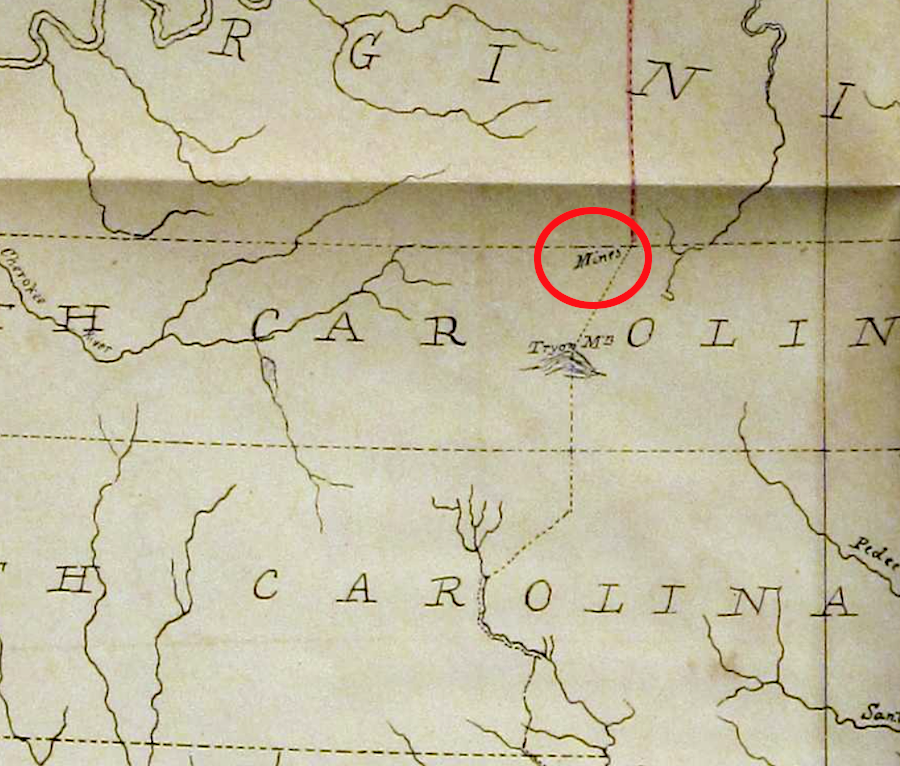
Chiswell's Mines were use to mark the limit of lands ceded by the Cherokee in the 1768 Treaty of Hard Labor
Source: Historical Maps of Pennsylvania, 1768.9
The line of demarcation in 1768 did not follow the river. Mining operations on both the north and south banks would not violate that treaty, but there was little activity at the time. Any question regarding the claims of the Cherokee were eliminated when the 1770 Treaty of Lochaber extended their cession far to the west of the New River.
The New River ran through the ore deposit. To simplify mining operations, the river was later diverted at Austinville so all the digging occurred on the south bank.4
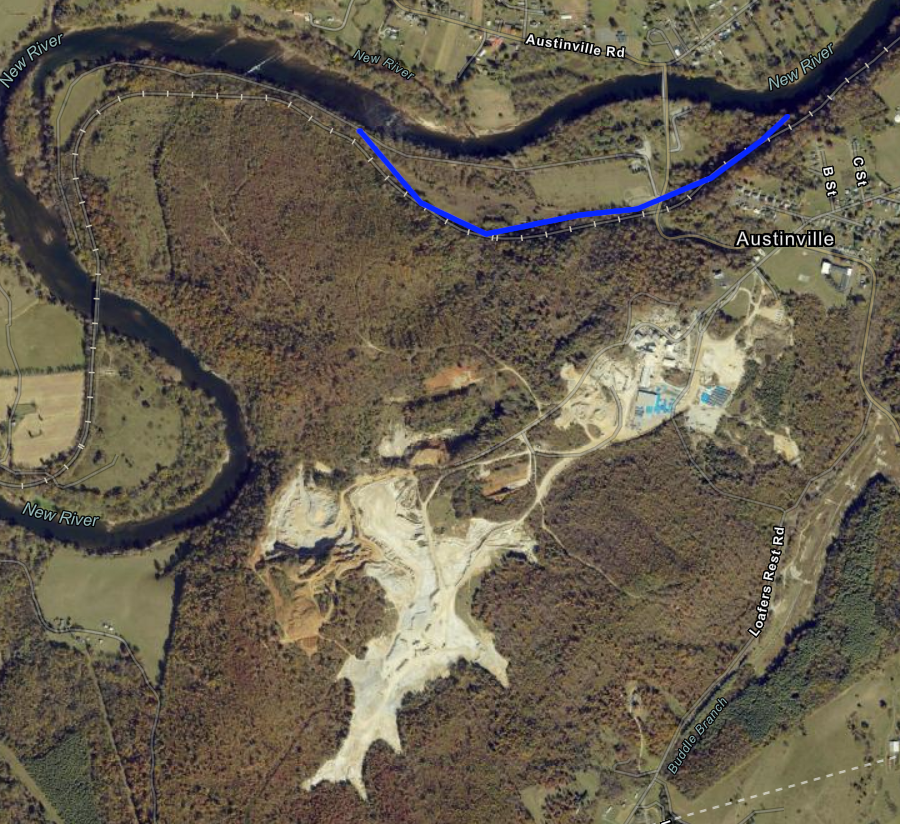
the New River was rerouted from its original channel (blue line) to provide access to the ore body
Source: Esri, ArcGIS Online
Despite the treaties negotiated after the Proclamation of 1763, officials in London never issued clear guidance to the royal governor that would allow finalizing grants and encouraging western settlement. As a result, settlement was constrained in the western counties. Lead mining so far from the primary customers in the cities was marginal and unprofitable until the American Revolution.
Demand increased after King George III issued an Order in Council on October 19, 1774 that banned the export of military equipment to the insurrectionist North American colonies. Colonial leaders recognized that not only did they need to smuggle in weapons and gunpowder past the British Navy to prepare to fight, but they also needed to mine domestic lead for musket balls and pellets. In mid-1775, the Fincastle County of Safety rented the lead mines.5
Colonel Charles Lynch, militia leader in Bedford County, started manufacturing gunpowder in 1775. He was appointed superintendent of the lead mines in 1777, replacing James Callaway. Callaway had managed the lead mines since 1776. Lynch managed the mining operations until 1787.6
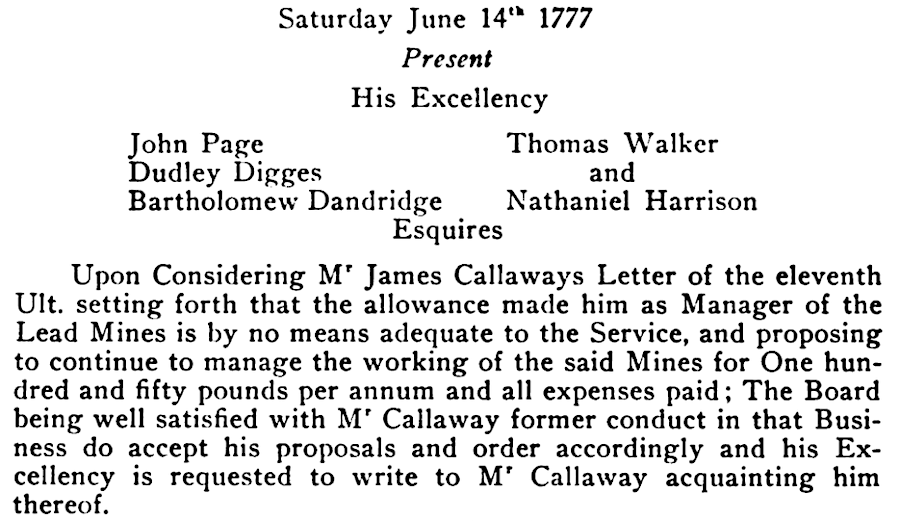
James Callaway managed the lead mines in 1776-1777
Source: HathiTrust, Journal of the Council of the State of Virginia (June 14, 1777, p.432)
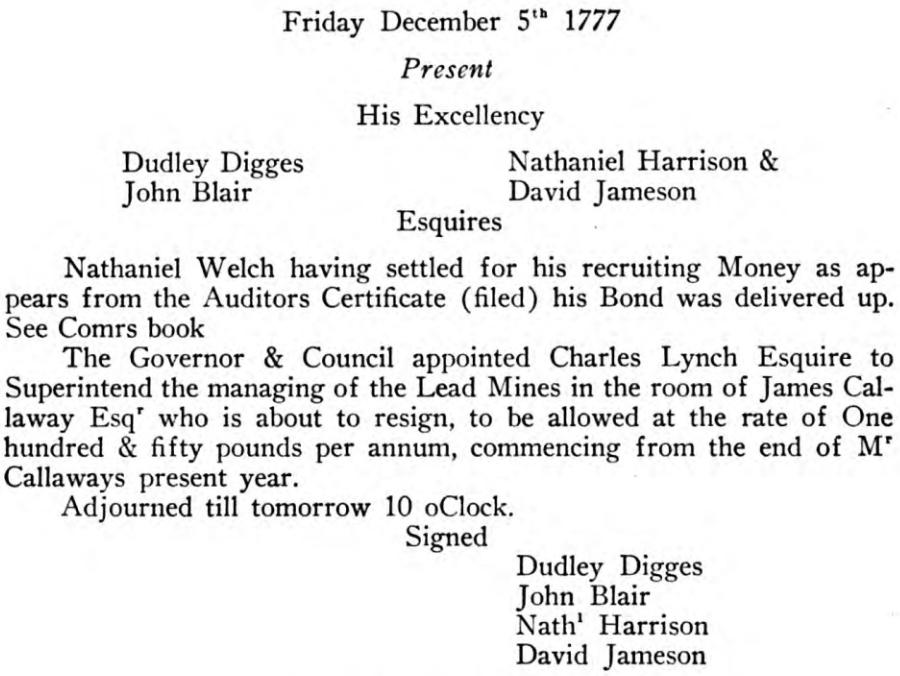
Charles Lynch was appointed superintendent of the lead mines by the Council of State at the end of 1777
Source: HathiTrust, Journal of the Council of the State of Virginia (December 5, 1777, p.42)
Lynch had started producing gunpowder, which was essential for the war effort, in 1775. Virginia's military leaders determined how to distribute the gunpowder and lead that he produced, and provided financial support for those activities.
Much of the lead was taken by wagon 130 miles to the James River and floated from what today is Lynchburg to Westham, just upstream of Richmond, for transformation into balls for the smoothbore Brown Bess muskets used by the militia and Continental Army. Not until the early 1800's was a "shot tower" to manufacture pellets constructed. That tower was built on the New River at Jackson's Ferry.

Governor Patrick Henry and the Council of State allocated lead and gunpowder from the mines at Austinville in 1778
Source: HathiTrust, Journal of the Council of the State of Virginia (February 5, 1778, p.80)
To ensure an adequate labor force, convicts and enslaved men and women who had sought to flee to the British were forced to work at the lead mines. Those who had fled slavey but been recaptured faced the death penalty. The Council of State chose instead to pay their owners the value of the enslaved workers and then send them to the lead mine as "public negroes." That re-enslaved the men, isolated them from others who might have been encouraged to escape, and provided the labor needed to produce military supplies.
Virginia's revolutionary leaders had many personal rivalries and different opinions regarding the issue of the moment. However, they consistently supported the lead mines by sending enslaved workers there to maintain and expand the labor force.
The mines served as a work camp for men who were caught trying to flee to the British lines, or who demonstrated what the leaders considered to be "disloyalty" regarding the rebellion against British rule. Though the enslaved labor force at the mines was only about 30 men and women, the threat to be sent to the mines was used throughout Virginia to control the behavior of disaffected enslaved workers. They dreaded the especially hard labor there, digging ore and cutting the wood used to fuel the furnaces that smelted the lead ore:7
- The furnace was a mile from the mine. The ore was hauled on wagons to the riverbank, canoed to the opposite shore, then dumped into wagons and hauled to the furnace. A water-powered mill broke up the ore. The ore was washed to get the dirt off, then dumped into a wood-fired furnace. The molten metal flowed into molds to form 150-pound bars. A hundred pounds of washed ore yielded 50 to 80 pounds of metal.

when enslaved workers were recaptured, the General Assembly paid owners for them and sent the men to the lead mines
Source: HathiTrust, Journal of the Council of the State of Virginia (November 5, 1777, p.22)
The lead mines were in Montgomery County during most of the American Revolution. Fincastle County, created from Botetourt County in 1772 as more colonists settled the region, was carved up into Kentucky, Montgomery, and Washington counties at the end of 1776. Wythe County, home of Austinville today, was not created until 1790.
Loyalists in southwestern Virginia attempted to seize the mines in the late summer of 1780, hoping to disrupt the revolutionary effort. After British forces captured Charles Town and were winning battles in South Carolina, loyalists near the mines anticipated that the Regulars would march north. The loyalists also expected that efforts to interrupt the flow of lead to the militia and Continental Army forces in the Carolinas would be rewarded when royal rule was reestablished.
Montgomery County leaders discovered the plot, in part by inserting a spy into the loyalist group. With the assistance of militia from nearby counties, they arrested the loyalists and imprisoned 75 men. Many were whipped or forced to join the Continental Army, but Governor Thomas Jefferson requested that the top 16 leaders be sent to Richmond for trial.
Taking them across the state required time and involved the risk of escape. Colonel John Lynch chose to mete out justice at his Green Level plantation home on the Roanoke River, in what today is the town of Altavista. Most of those 16 loyalists were found guilty in trials conducted under "Lynch law," with little attention to giving the defendants due process.
Those who were convicted were given the option of joining the Continental Army or being whipped 39 times. If they cried out "Liberty Forever" while being whipped, the whipping would stop - but they still had to join the Continental Army.8
Demand for bullets dropped at the end of the American Revolution, but there were other customers. The new Virginia State Capitol replaced its flat roof in 1789 with a pediment roof which was covered in lead. That was replaced in 1797.
The state put the mines up for auction in 1780. Stephen and Moses Austin moved from Connecticut to Virginia and operated the mines for most of the 1790's. The settlement at the mines gained the name of Austinville during that period. In 1791 Colonel Charles Lynch finally patented 1,400 acres, just upstream from the mines.9
The Austins did not finish paying their debt to the state. Moses Austin moved to Missouri in 1798 and started the lead mining industry there. A former blacksmith at the mine, Thomas Jackson, purchased the lead mines at auction in 1806. According to local lore, he won the bid by walking faster to Richmond than his competitors. Unlike them, Jackson did not stop to drink at taverns on his journey.
Thomas Jackson and David Pierce arranged to run separate operations to extract the lead. Jackson built his shot tower where lead was melted and dropped 150 feet, forming round pellets before landing in a pool of water. The shot tower is now a state park, after being owned by the Daughters of the American Revolution between 1929-1952 and the Lead Mines Ruritan Club between 1952-1964.
Jackson died in 1824. The Wythe Lead Mines Company was organized in 1838. After a reorganization a decade later, Wythe Union Lead Mine Company was responsible for the mine. In 1860, the Union Lead Mining Company was in charge.
Lead ore was smelted at the mines to produce "pigs" that were shipped by wagon to market. After the Virginia and Tennessee Railroad was constructed, the lead was carried to the railroad depot at Max Meadows.10
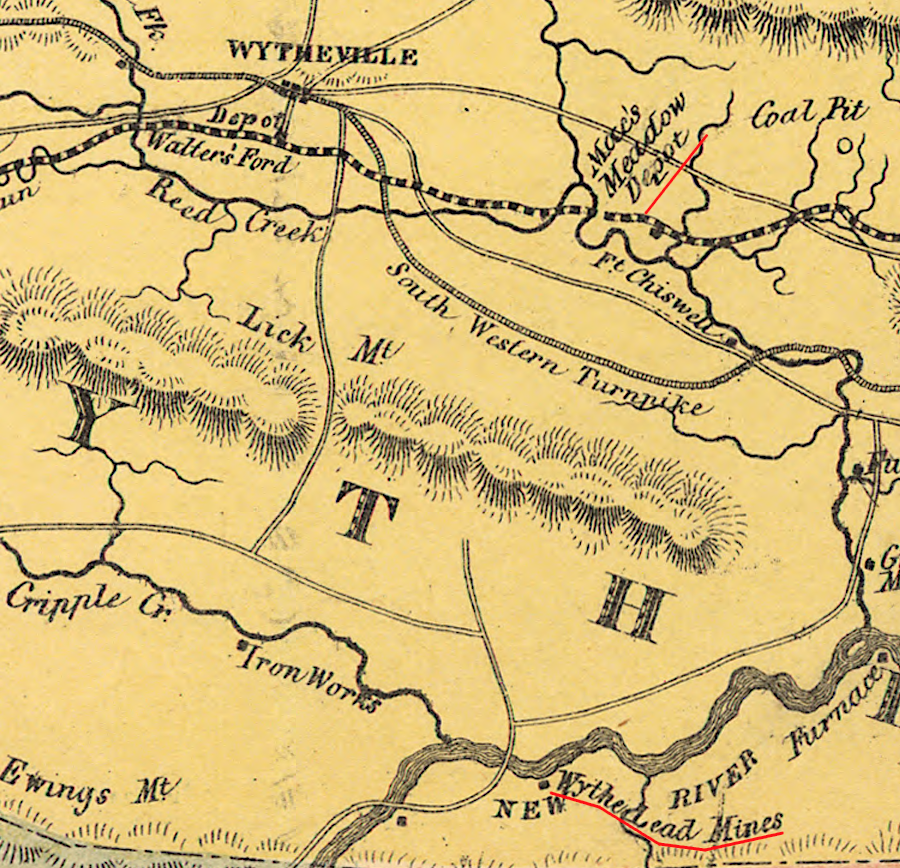
after construction of the Virginia and Tennessee Railroad, lead was shipped to the Max Meadows depot
Source: Library of Congress, Map & profile of the Virginia & Tennessee Rail Road (William Willis Blackford, 1856)
During the Civil War, the "Union Mines" provided 1/3 of the lead for cartridges used by Confederate soldiers. Zinc was also produced and shipped to Richmond.
The commander leading a Union Army force to destroy the salt works at Saltville in July, 1863 switched targets and headed instead to the lead mines. In the Battle of Wytheville, Confederates killed the Federal commander and forced the cavalry to retreat. Later Union cavalry raids on December 17, 1864 and April 5, 1865 damaged the above-ground facilities, but mining resumed after the war ended.
The Bertha Mineral Company focused on extracting zinc from the ore deposit. New Jersey Zinc purchased it in 1902. It extracted both lead and zinc, increasing production after adopting the new flotation process in 1924 to separate zinc and lead concentrates. The concentrates were shipped to Pennsylvania for smelting. The lead was used as a pigment to produce white paint.
The New Jersey Zinc Company officially closed the mines on December 31, 1981. Between 1756-1781, 30 million tons of lead and zinc were produced from the Austinville-Ivanhoe district. The ore extracted from lenses in the Shady Formation had 0.8% lead and 3.9% zinc.
The James River Limestone Company bought the site in 1982, and the last operations focused on mining limestone. Much of the site has been reclaimed, and some of the former lead mine acreage is part of New River Trail State Park. Since 1996, the Austinville Limestone Company has quarried limestone and ground it for agricultural, lawn, and ornamental use.11
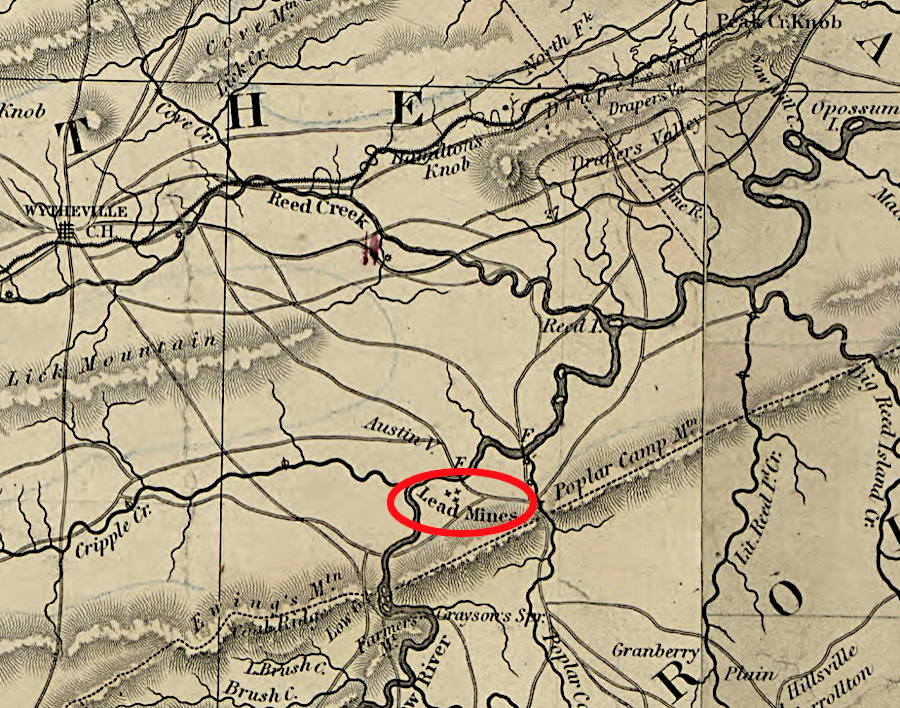
the lead mines supplied bullets for the Civil War, as well as musket balls during the Revolutionary War
Source: Library of Congress, A map of the state of Virginia, constructed in conformity to law from the late surveys (Ludwig von Buchholtz, 1859)
Links
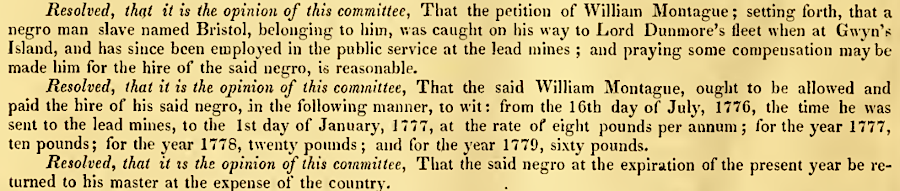
enslaved workers captured while fleeing to the British during the Revolutionary War were forced to work in the lead mines
Source: Journal of the House of Delegates of the Commonwealth of Virginia (June 10, 1779)
References
1. Jess Lowry, "Shot Tower Historical State Park and Jackson's Ferry," New River Symposium, 1984, http://npshistory.com/series/symposia/new_river/sec1.htm; Mary B. Keley, "Fort Chiswell and Chiswell's Lead Mines of Wythe County, Virginia: A New Perspective," Smithfield Review, Volume XIV (2010), https://vtechworks.lib.vt.edu/items/cdb72669-552e-4446-a5e2-ff516f492f97; "Fort Chiswell Site," Virginia Department of Historic Resources, https://www.dhr.virginia.gov/historic-registers/098-0026/; Sean Gallagher, "Chiswell's Lead Mines in the American Revolution," Encyclopedia Virginia, Virginia Humanities, July 2, 2025, https://encyclopediavirginia.org/entries/chiswells-lead-mines-in-the-american-revolution/ (last checked June 22, 2026)
2. Mark Wilcox, "Was it Murder in Virginia?," Emerging Revolutionary War Era, January 28, 2026, https://emergingrevolutionarywar.org/2016/01/28/was-it-murder-in-virginia/; Brent Tarter and Dictionary of Virginia Biography, "John Robinson (1705–1766)," Encyclopedia Virginia, Virginia Humanities, December 7, 2020; Joseph Albert Ernst, "The Robinson Scandal Redivivus: Money, Debts, and Politics in Revolutionary Virginia," The Virginia Magazine of History and Biography, Volume 77, Number 2 (April 1969), p.168, https://www.jstor.org/stable/4247470; Brent Tarter, and Dictionary of Virginia Biography, "John Robinson (1705–1766)," Encyclopedia Virginia, Virginia Humanities, December 7, 2020, https://encyclopediavirginia.org/entries/robinson-john-1705-1766/; Joseph Albert Ernst, "The Robinson Scandal Redivivus: Money, Debts, and Politics in Revolutionary Virginia," The Virginia Magazine of History and Biography, Volume 77, Number 2 (April 1969), p.168, https://www.jstor.org/stable/4247470 (last checked June 17, 2026)
3. William Ogilvy, "The Treaty of Hard Labor (October 14, 1768)," Encyclopedia Virginia, Virginia Humanities, February 17, 2025, https://encyclopediavirginia.org/primary-documents/the-treaty-of-hard-labor-october-14-1768/ (last checked June 22, 2026)
4. William Ogilvy, "The Treaty of Lochaber (October 18, 1770)," Encyclopedia Virginia, Virginia Humanities, February 17, 2025, https://encyclopediavirginia.org/primary-documents/the-treaty-of-lochaber-october-18-1770/; Lawrence J. Fleenor, Jr., "The Lead Mines Of Austinville," Big Stone Gap Publishing.net, July 25, 2020, https://www.bigstonegappublishing.net/THE%20LEAD%20MINES%20OF%20AUSTINVILLE.pdf (last checked June 22, 2026)
5. "October 19, 1774," Colonial Williamsburg, https://www.ouramericanrevolution.org/index.cfm/page/view/p0334; Sean Gallagher, "The Prison of Public Works: Enslaved People and State Formation at Virginia's Chiswell Lead Mines, 1775–1786," The Journal of Southern History, Volume 86, Number 4 (November 2020), p.778, https://www.jstor.org/stable/27267286 (last checked June 23, 2026)
6. "James Callaway," Dictionary of Virginia Biography, https://old.lva.virginia.gov/public/dvb/bio.asp?b=Callaway_James (last checked June 23, 2026)
7. Sean Gallagher, "Chiswell's Lead Mines in the American Revolution," Encyclopedia Virginia, Virginia Humanities, July 2, 2025, https://encyclopediavirginia.org/entries/chiswells-lead-mines-in-the-american-revolution/; "At Chiswell's mines, a mixed crew of unwilling hands dug lead ore for patriot victory," Cardinal News, March 12, 2024, https://cardinalnews.org/2024/03/12/at-chiswells-mines-a-mixed-crew-of-unwilling-hands-dug-lead-ore-for-patriot-victory/; "Colonel Charles Lynch," Avoca Museum and Historical Society, https://www.avocamuseum.org/col-charles-lynch; Sean Gallagher, "The Prison of Public Works: Enslaved People and State Formation at Virginia's Chiswell Lead Mines, 1775–1786," The Journal of Southern History, Volume 86, Number 4 (November 2020), p.781-783, https://www.jstor.org/stable/27267286; "At Chiswell's mines, a mixed crew of unwilling hands dug lead ore for patriot victory," Cardinal News, March 12, 2024, https://cardinalnews.org/2024/03/12/at-chiswells-mines-a-mixed-crew-of-unwilling-hands-dug-lead-ore-for-patriot-victory/ (last checked June 24, 2026)
8. "Col. Lynch had Loyalists tied to a tree and whipped until they cried 'Liberty Forever!' That’s where the term 'Lynch law' comes from," Cardinal News, June 16, 2026, https://cardinalnews.org/2026/06/16/col-lynch-had-loyalists-tied-to-a-tree-and-whipped-until-they-cried-liberty-forever-thats-where-the-term-lynch-law-comes-from/; "A barrel-maker from Botetourt County became a spy who uncovered 'a most horrid conspiracy' among Virginia Loyalists," Cardinal News, April 15, 2026, https://cardinalnews.org/2025/04/15/a-barrel-maker-from-botetourt-county-became-a-spy-who-uncovered-a-most-horrid-conspiracy-among-virginia-loyalists/; "At Chiswell's mines, a mixed crew of unwilling hands dug lead ore for patriot victory," Cardinal News, March 12, 2024, https://cardinalnews.org/2024/03/12/at-chiswells-mines-a-mixed-crew-of-unwilling-hands-dug-lead-ore-for-patriot-victory/ (last checked June 17, 2026)
9. "Virginia State Capitol (Capitol of Virginia)," Virginia Department of Historic Resources, https://www.dhr.virginia.gov/historic-registers/127-0002/; Lawrence J. Fleenor, Jr., "The Lead Mines Of Austinville," Big Stone Gap Publishing.net, July 25, 2020, https://www.bigstonegappublishing.net/THE%20LEAD%20MINES%20OF%20AUSTINVILLE.pdf; "Stories from the Trail: The Austins, Lead, and the Father of Texas," Virginia State Parks, March 5, 2020, https://www.dcr.virginia.gov/state-parks/blog/stories-from-the-trail-the-austins-lead-and-the-father-of-texas (last checked June 24, 2026)
10. Robert C. Whisonant, "Geology and the Civil War in southwestern Virginia: The Wythe County Lead Mines," Virginia Minerals, Volume 42, Number 2 (May 1996), https://www.energy.virginia.gov/commerce/ProductDetails.aspx?productID=2837; Jess Lowry, "Shot Tower Historical State Park and Jackson's Ferry," New River Symposium, 1984, http://npshistory.com/series/symposia/new_river/sec1.htm; Lawrence J. Fleenor, Jr., "The Lead Mines Of Austinville," Big Stone Gap Publishing.net, July 25, 2020, https://www.bigstonegappublishing.net/THE%20LEAD%20MINES%20OF%20AUSTINVILLE.pdf
(last checked June 17, 2026)
11. Robert C. Whisonant, "Geology and the Civil War in southwestern Virginia: The Wythe County Lead Mines," Virginia Minerals, Volume 42, Number 2 (May 1996), https://www.energy.virginia.gov/commerce/ProductDetails.aspx?productID=2837; "New Jersey Zinc Company: A Legacy of Mining," Virginia Energy, https://energy.virginia.gov/mineral-mining/NewJerseyZincCompany.shtml; "Welcome to Austinville Limestone Company," Austinville Limestone Company, https://avlime.com/ (last checked June 24, 2026)
Rocks and Ridges - The Geology of Virginia
Virginia Places