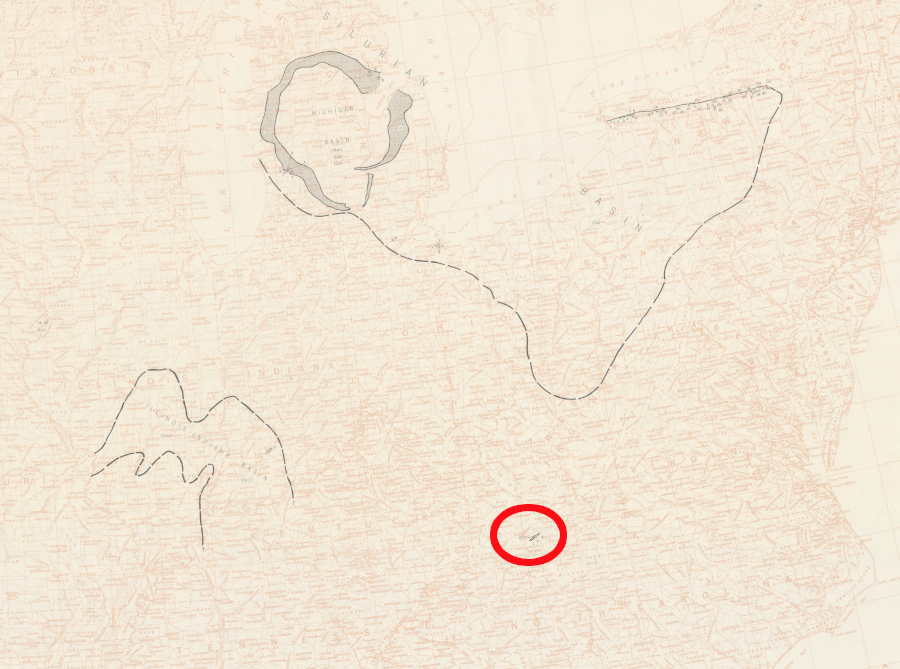
concentrated gypsum deposits worth commercial exploitation were found in southwest Virginia
Source: US Geological Survey (USGS), Gypsum and anhydrite in the United States, exclusive of Alaska and Hawaii
concentrated gypsum deposits worth commercial exploitation were found in southwest Virginia
Source: US Geological Survey (USGS), Gypsum and anhydrite in the United States, exclusive of Alaska and Hawaii
Gypsum is used to make drywall/wallboard which is installed inside buildings:1
Gypsum deposits in Virginia were created about 350 million years ago. Rivers carried dissolved minerals and sediments downstream into basins. As the basins dried up, dissolved salts precipitated to the bottom and accumulated together with fine clay particles as sediments in the Maccrady Formation. The basins were near the coastline of the Iapetus Ocean at the time; the Blue Ridge, Piedmont, and Coastal Plain had not been formed yet.
Gypsum has been found by rovers exploring the surface of Mars. It indicates the former presence of seawater, in which life may have evolved.
Then the flat sedimentary beds of "evaporites" were cracked, folded, and thrust westward during the Alleghany Orogeny as Pangea formed. The evaporites were buried under rocks thrust on top, plus new sediments. 250 million years of erosion have brought the salts in the Maccrady Formation near the surface again. The salt beds are fragmented into discontinuous pods now, reflecting the formation in separate evaporating basins plus the rearrangement of bedrock by tectonic forces.2
Chemically, gypsum is hydrated calcium sulfate or CaSO4·2(H2O). Gypsum is over 20% water by weight. In a fire, wallboard heated to 212°F will release the "water of crystallization" and help minimize the spread of flames within a building.
If water (H2O) is not incorporated within the calcium sulfate molecule, then anhydrite (CaSO4) is formed. If exposed to water, anhydrite will quickly dissolve to form gypsum.
Surface sands formed from gypsum are rare because rainwater dissolves the mineral so easily. In the desert of New Mexico, the sands at White Sands National Park are gypsum crystals.3
If calcium sulphate crystals contain half the amount of water - CaSO4·0.5H2O or 2CaSO4·H2O - then the product is "plaster of Paris" (bassanite). That material was used for making casts to immobilize broken bones and for art and architectural molds. Adding water to dry plaster converts it into a paste which can be shaped around the edges of objects. In less than an hour, plaster dries and becomes hard. "Death masks" were made from plaster of Paris.
Adding 3-5% of gypsum along with clay produces Portland cement that can be smeared on building material before it hardens.
Before wallboard was developed, plaster was smeared over wooden lath to create walls. Gypsum is still spread across the seams of wallboard pieces to hide the edges and create a consistently smooth surface.4
At coal-fired power plants, calcium carbonate was used to trap the sulfur in smokestack emissions. Flue gas desulfurization provided another source of gypsum, in addition to mining the material.
Virginia had one commercial gypsum deposit. Outcrops from the Maccrady Formation in Smyth and Washington counties, particularly Rich Valley, were being used by 1830:5
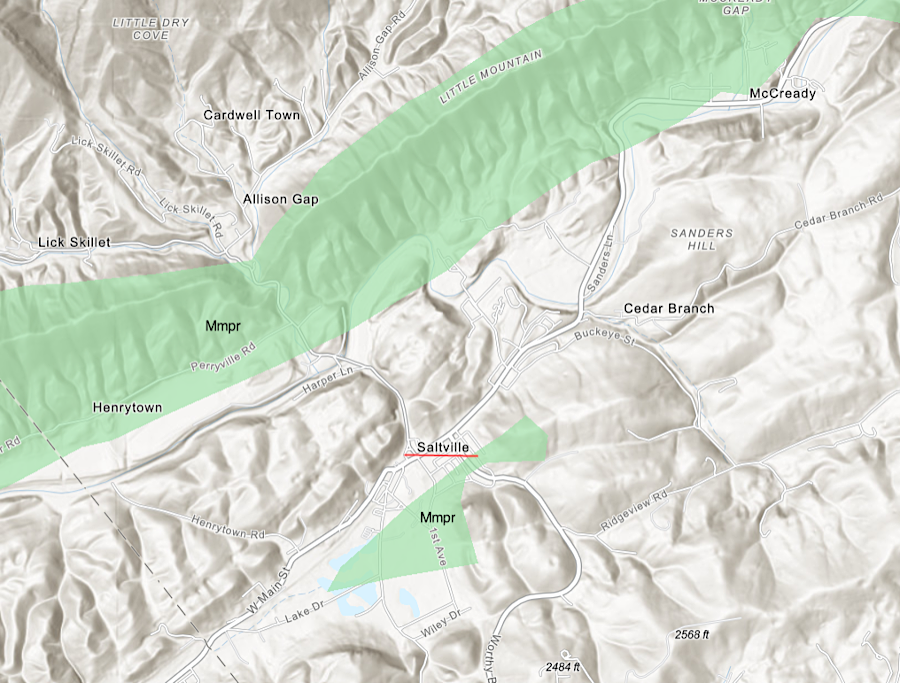
there are narrow bands of the Maccrady/Price Formation from the Tennessee border to the New River
Source: Virginia Department of Energy, Geology and Mineral Resources
The calcium-rich and sulfur-rich product was initially ground up and used as a fertilizer and soil amendment that reduced pH and "sweetened" acidic soil, so plant roots could extract minerals.
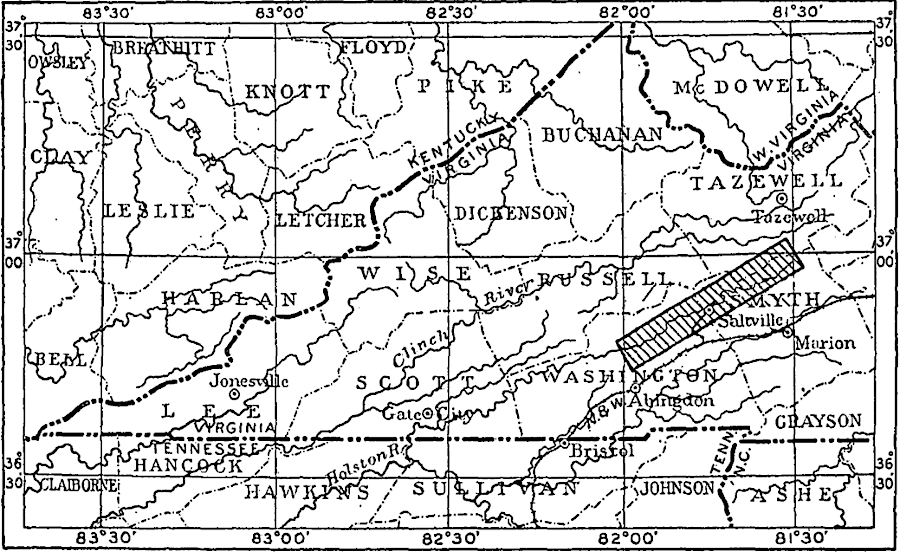
gypsum was mined in southwest Virginia for over 150 years
Source: US Geological Survey (USGS), Gypsum Deposits of the United States (Figure 54)
The Buena Visata Plaster Company was organized in 1808 to mine the "plaster banks" in Smyth County. The product, useful for enhancing the productivity of cropland, could be shipped by batteaux floating during times of high water down the North Fork of the Holston River to Kingsport.
Around 1890, a factory in Washington County began to heat gypsum to pulverize and "calcine" (heat) gypsum. The product was used as plaster or (when mixed with sand) as stucco for exterior surfaces. The Saltville branch of the Norfolk & Western Railway moved the product to market. The town of Plasterco developed around the factory. Gypsum operations in other states also resulted in similar place names - Gypsum, Ohio; Alabaster, Michigan; Plaster City, California.
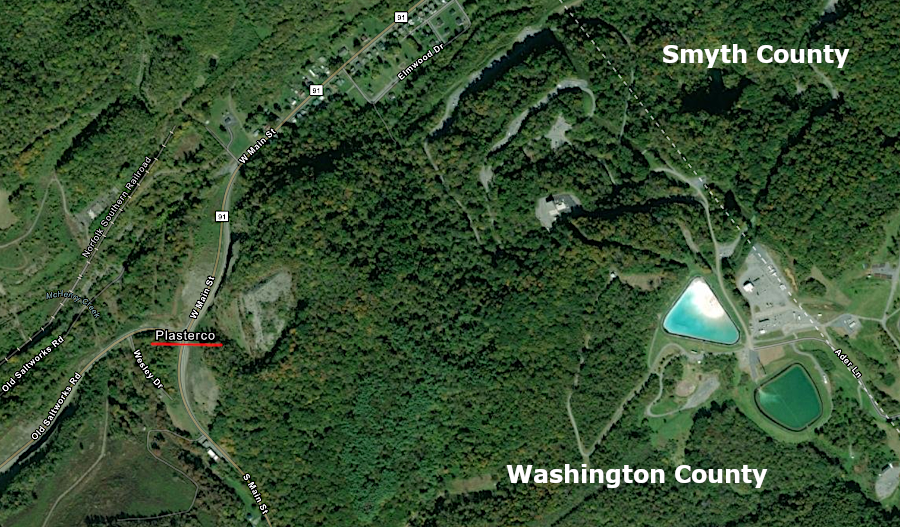
Plasterco is in Washington County, near the Smyth County border
Source: ESRI, ArcGIS Online
United States Gypsum acquired the mines of the Buena Vista Plaster Company in 1909. The Southern Gypsum Company also operated near Plasterco in the early 1900's.
In the 1960s US Gypsum opened the Locust Cove mine in 1965. It was just across the county line in Smyth County.
The Locust Cove mine became the deepest underground gypsum mine in the United States, reaching 800' underground, before closing in 1999. By 2022 there were just three underground gypsum mines still operating in North America; all others were surface quarries. Underground gypsum mining in Virginia used the room-and-pillar method, similar to underground coal mines:6
Surface mining was simpler. As described by the executive vice president for manufacturing for US Gypsum:7
Locust Cove operated until 1999. On November 4, 1984, about 20 acres around the US Gypsum wallboard factory subsided six feet; some holes were 75' deep. Damage to the company facilities, Highway 745, and the Norfolk and Western Railroad cost $34 million to repair. Mining underneath the factory, which began in the 1800's, had stopped in 1979. US Gypsum had flooded the mine to the ninth level after abandoning it, in hopes of preventing subsidence. The company had to sue its insurance company to be paid for its coverage under the all-risk policy.8
U.S. Gypsum closed the factory at Plasterco when it built a new wallboard production plant at Bridgeport, Alabama. The Alabama site offered lower transportation costs using both rail and barge on the Tennessee River.
The company invested $132 million in 2005 to upgrade and expand its wallboard production plant in Norfolk. It had manufactured gypsum products at that location, with excellent rail and water connections, since shortly after World War II.9
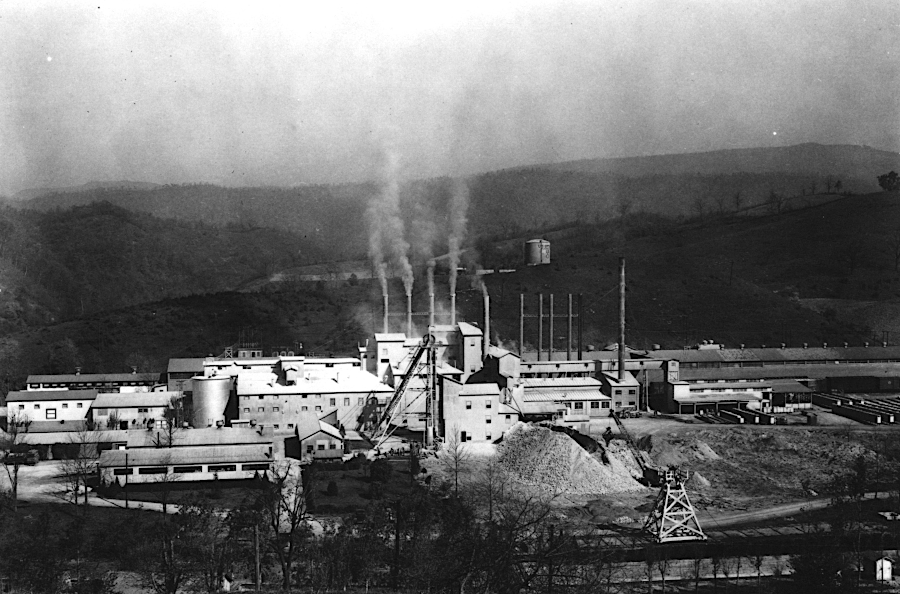
gypsum was heated ("calcined") to create plaster at Plasterco in Washington County
Source: Virginia Tech Special Collections and University Archive, U.S. Gypsum Co., Plasterco, Virginia
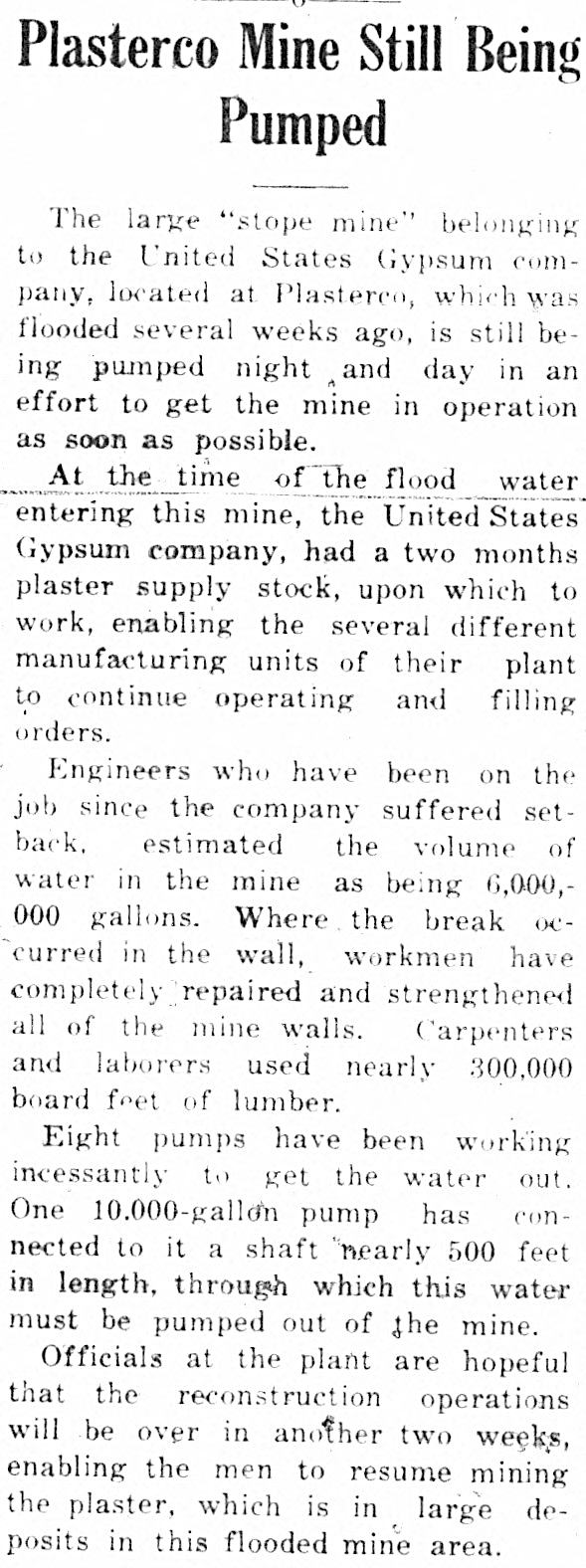
the underground Plasterco Mine near the company's production facilities flooded in 1935
Source: Virginia Chronicle, Smyth County News (August 15, 1935)