
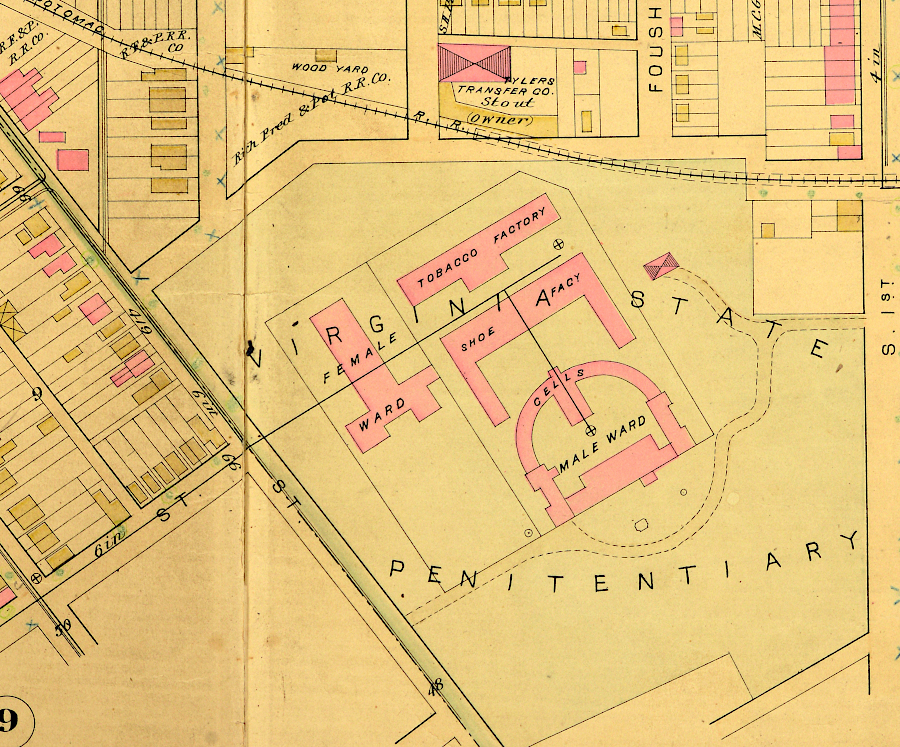
the State Penitentiary was built on Gambles Hill in Richmond
Source: Virginia Commonwealth University (VCU), State Penitentiary, Richmond, Va.; Baist Atlas of Richmond, VA (1889)
the State Penitentiary was built on Gambles Hill in Richmond
Source: Virginia Commonwealth University (VCU), State Penitentiary, Richmond, Va.; Baist Atlas of Richmond, VA (1889)
There was no long-term imprisonment for major crimes in colonial Virginia. Virginia counties built short-term jails to hold people until a trial, but not long-term prisons to incarcerate people.
After conviction:1
People convicted of capital crimes were executed at a gallows in Williamsburg soon after the General Court condemned them. There was a broad range of crimes which qualified for the death penalty.
At the time of the American Revolution, a new concept in punishment was advocated by the Quakers in Pennsylvania. They proposed to reform criminals by placing them in a building for a period of time, during which they could contemplate their past, become penitent, and change their behavior before being released.
Thomas Jefferson led the charge in Virginia to modify state laws, and he proposed a "Bill for Proportioning Crimes and Punishments in Cases Heretofore Capital" in 1785. Jefferson also sketched out designs of a prison where people could be held in solitary confinement to labor and to reflect upon their sins.
In 1795 the General Assembly adopted a modified version of Jefferson's bill. The new approach required construction of a prison designed to incarcerate people. Counties continued to maintain jails for people being held before trial, but those sentenced for imprisonment for a long period of time were sent to the state penitentiary after it was built in Richmond in 1800.
The first site proposed for the prison was at the corner of First and Franklin streets. An influential nearby resident objected; the city library was eventually constructed at that location. The prison was erected on Gamble's Hill, overlooking the James River.
Benjamin Henry Latrobe designed the new state penitentiary. It represented the new approach to punishment, with imprisonment preferred over physical punishment or execution.
Thomas Jefferson's proposed design, based on a "panopticon" structure he had seen while in France that allowed guards to peer into cells from a central tower, was not chosen.
Latrobe's design, a semicircle with three stories of cells, did offer an efficient way to minimize the number of required guards. However, while guards had a clear line of sight from their station to the doors to each cell, there were no windows allowing the guards to look inside cells; they had to open doors to check on the status of prisoners.
Cells had no heat or toilet facilities. For a century, waste was collected in individual buckets. It ended up in a nearby pond that create a miserable smell inside the prison during warm days.
The state prison was designed to hold 900 people but it was often overcrowded. At one point there were 3,000 people imprisoned there, with six people in a single cell sleeping in hammocks.2
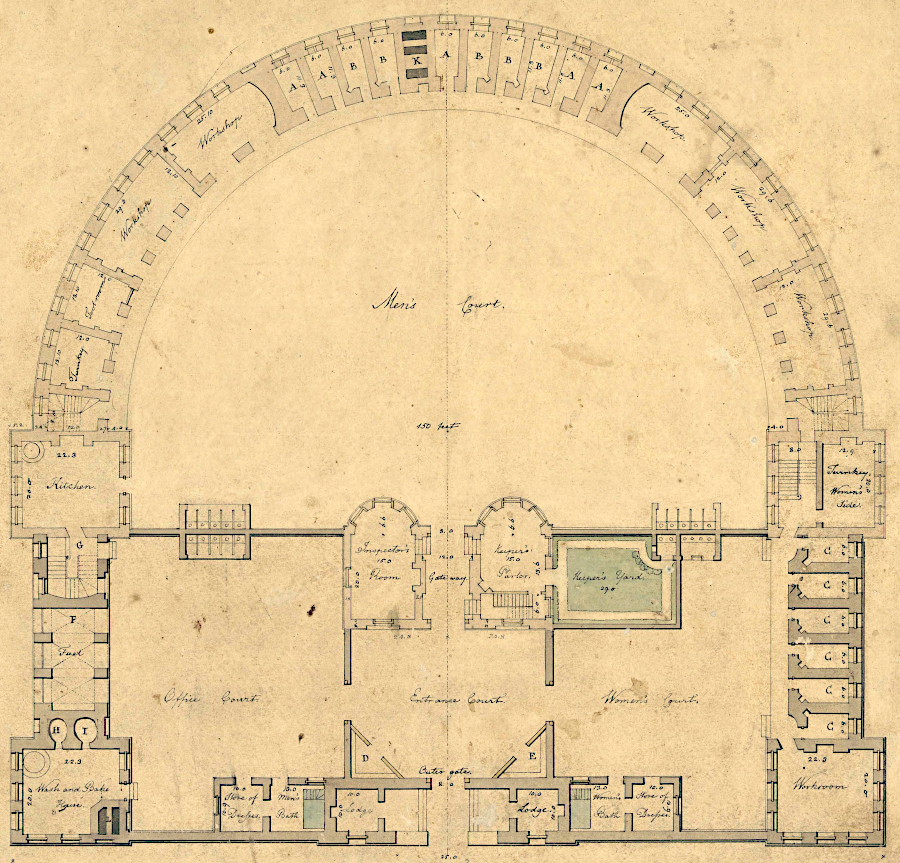
Latrobe's 1797 design was a semicircle with three floors of cells
Source: Library of Virginia, Benjamin Henry Latrobe Collection, Virginia State Penitentiary - proposed plans, elevations, and perspective drawings (1797)
The prison opened in 1800. The first person to be incarcerated there was a man who had murdered his rival in a love affair:3
In 1807, former Vice President Aaron Burr was incarcerated for a month at the state penitentiary during his trial for treason in Richmond. The state penitentiary buildings caught fire in 1823. An enslaved blacksmith, Gilbert Hunt, was part of the city's volunteer fire brigade and helped rescue the inmates; all 244 survived the fire.
Hunt later wrote about the sudden need for his blacksmith expertise:4
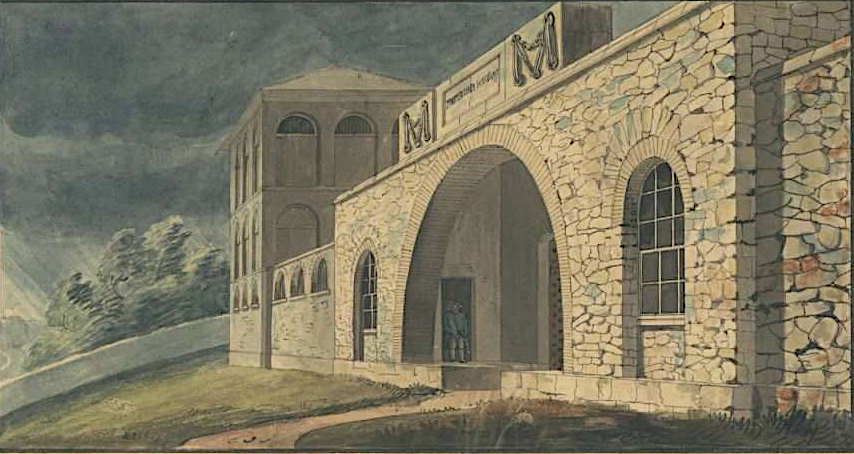
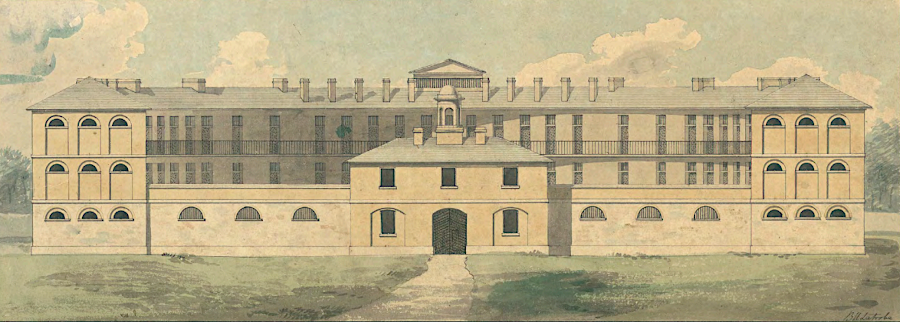
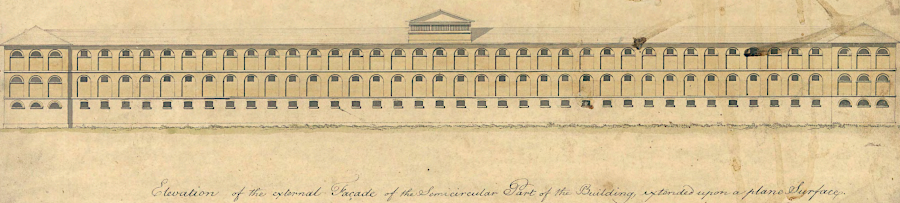
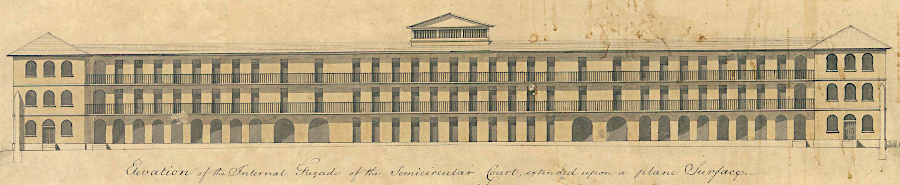
Benjamin Henry Latrobe planned the state prison built in Richmond
Source: Encyclopedia Virginia, The Virginia State Penitentiary; Library of Virginia, Benjamin Henry Latrobe Collection, Virginia State Penitentiary - proposed plans, elevations, and perspective drawings (1797)
The A Building at the state penistentiary was constructed in 1904. The B Building opened in 1942. C Building held the maximum security cells. Virginia applied its Jim Crow laws and segregated the prisoners until Federal judges forced change. Those judges also ruled that treatment of prisoners in 1971 qualifued as unconstitutional cruel and unusual punishment.
In the sentencing action after the landmark Landman v. Royster decision, the Federal judge went the extra mile and refused to allow the state to pay damages to three plaintiffs. The State Corrections Director was required to make payments from his personal funds.
As described by a prison reform advocate:5
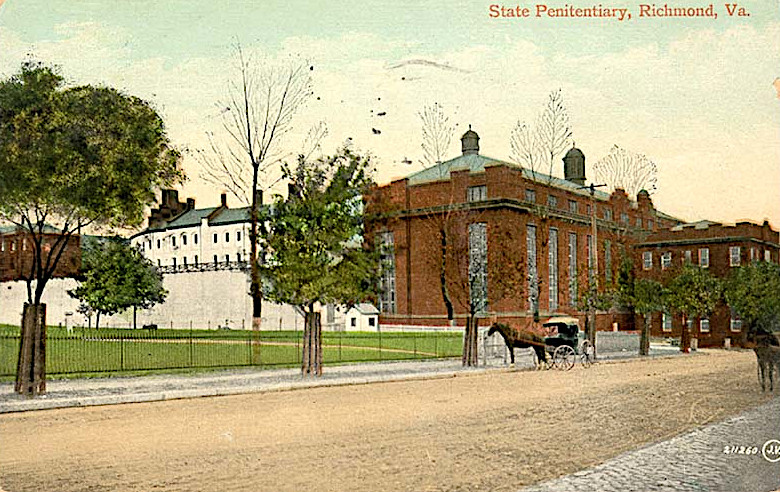
the State Penitentiary on Gambles Hill in Richmond
Source: Virginia Commonwealth University (VCU) Libraries, State Penitentiary, Richmond, Va.
The state government sold the site of the penitentiary at 500 Spring Street to the Ethyl Corporation in 1987. The Greensville Correctional Center in Greensville County and the Keen Mountain Correctional Center in Buchanan County were built to house the prisoners.
The A Building was closed first in April 1990. Prisoners not already transferred to other facilities were moved to the B Building.
In the final days of the B Building, two people were housed in individual cells and kept there for all but 90 minutes each day. The top bunk was so close to the ceiling that the man sleeping there could not sit upright on his bed.
On December 14, 1990, the last four prisoners were moved from B Building and the state penitentiary was closed. There are state prisons in multiple locations outside of Richmond, but none are known today as the "state penitentiary."
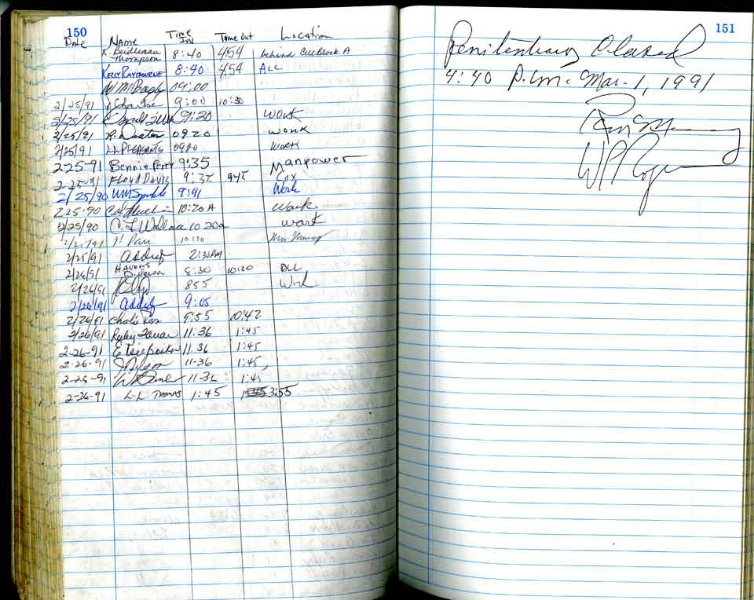
the state penitentiary closed on December 14, 1990 after the last four inmates were removed
Source: UnCommonwealth blog, Library of Virginia, "Down in the shadow of the penitentiary:" the Closing of the Virginia Penitentiary
The state retained control of the site for four more months because an electrocution was scheduled in early 1991. The electric chair in the A Building basement was needed; the electrical system at Greensville was not yet operational. For a brief time, public tours were offered of the old prison.
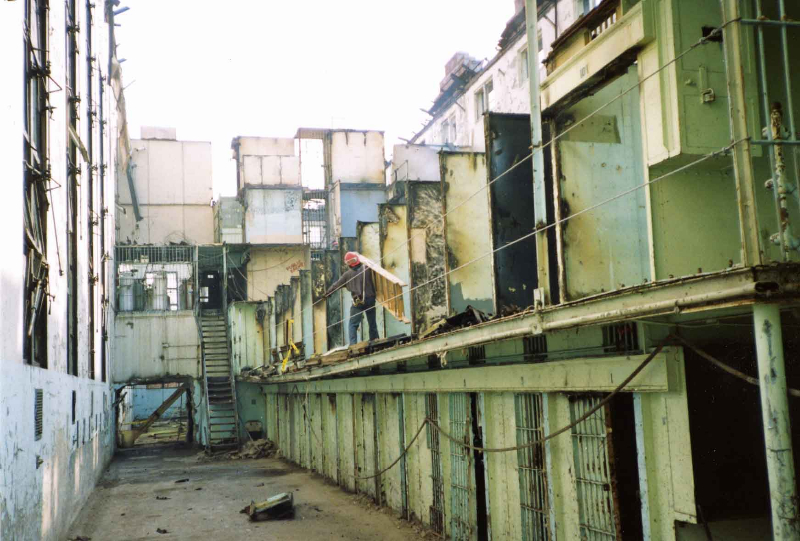
outside wall of cells in B Building, in August 1991 when demolition began
Source: UnCommonwealth blog, Library of Virginia, "Down in the shadow of the penitentiary:" the Closing of the Virginia Penitentiary
The inmate scheduled for execution was brought from the new Death Row at the Mecklenburg Correctional Facility to 500 Spring Street in Richmond. In February 1991, Governor Wilder commuted his death sentence to life imprisonment. After the execution was cancelled, the chair was moved to the Greensville Correctional Center and the prisoner was taken away.
Demolition of the old prison buildings began in August 1991. The site became the headquarters for Ethyl Corporation.6
Source: Virginia Museum of History and Culture, The Notorious History of the Virginia State Penitentiary
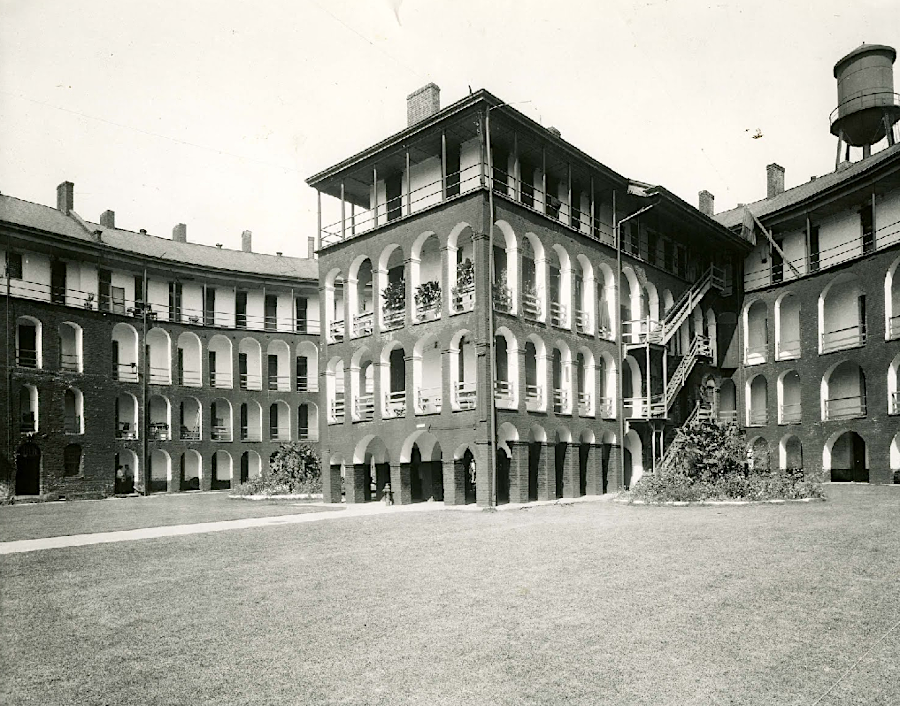
the state penitentiary was a fixture in Richmond until it closed in 1990
Source: Valentine Museum, Virginia State Penitentiary (Latrobe Design) (1928)
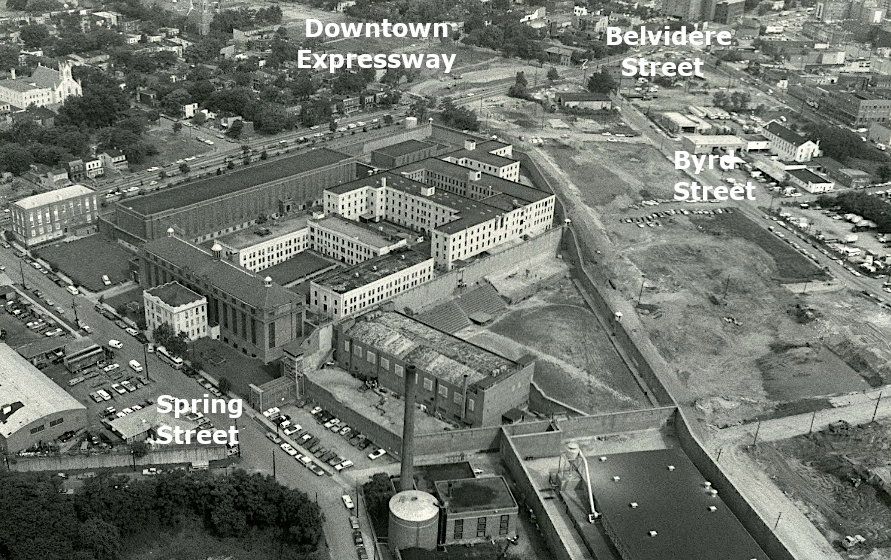
the state penitentiary, as the Downtown Expressway was being constructed in 1974
Source: Valentine Museum, Aerial view of Virginia State Penitentiary (by Bill Lane, 1974)
Source: Monument Avenue, "Inside the Walls" of the Springstreet Penitentiary
Source: Theme Parks With Brian, Virginia State Penitentiary 1991 Prison Tour
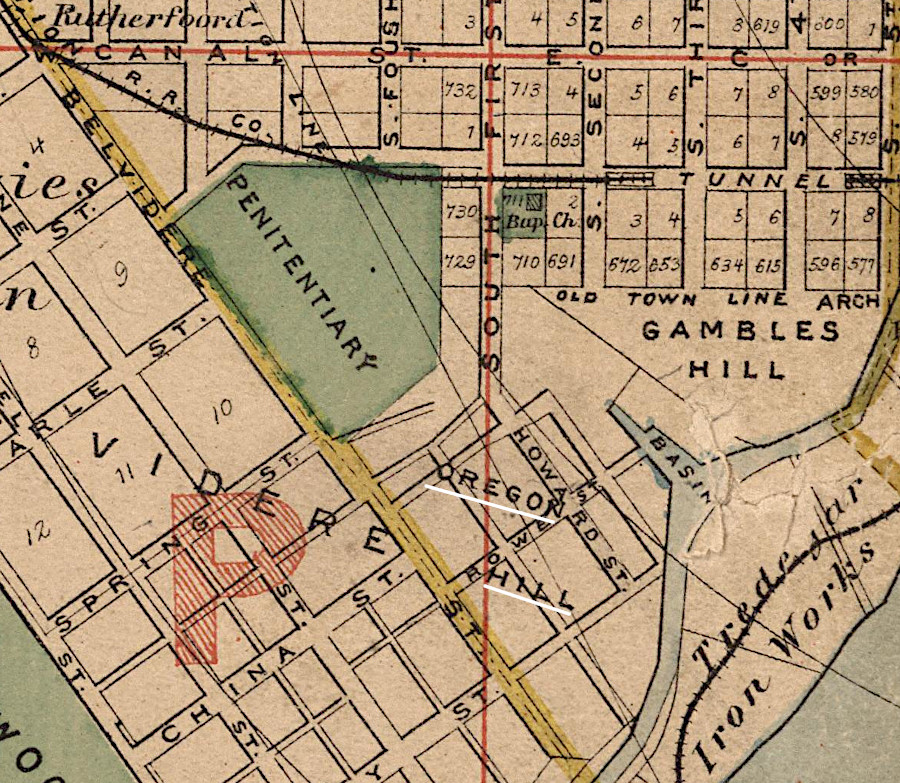
the first residents to build houses near the state penitentiary, far on the city outskirts, said they lived as far away as Oregon
Source: David Rumsey Historical Map Collection, Outline (Index) Map of Cities of Richmond and Manchester and Vicinity, Accompanying the Atlas of Richmond, Va (F.W. Beers, 1876)
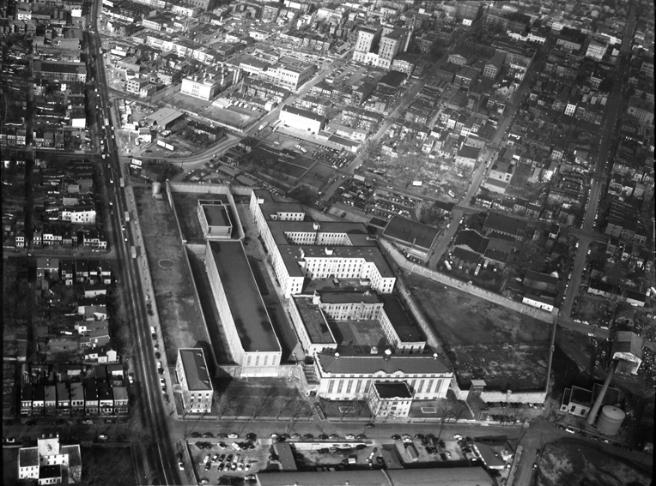
looking north at the state penitentiary in Richmond (January 24, 1954)
Source: UnCommonwealth blog, Library of Virginia, Johnny 99: The Records of the Virginia Penitentiary Now Available
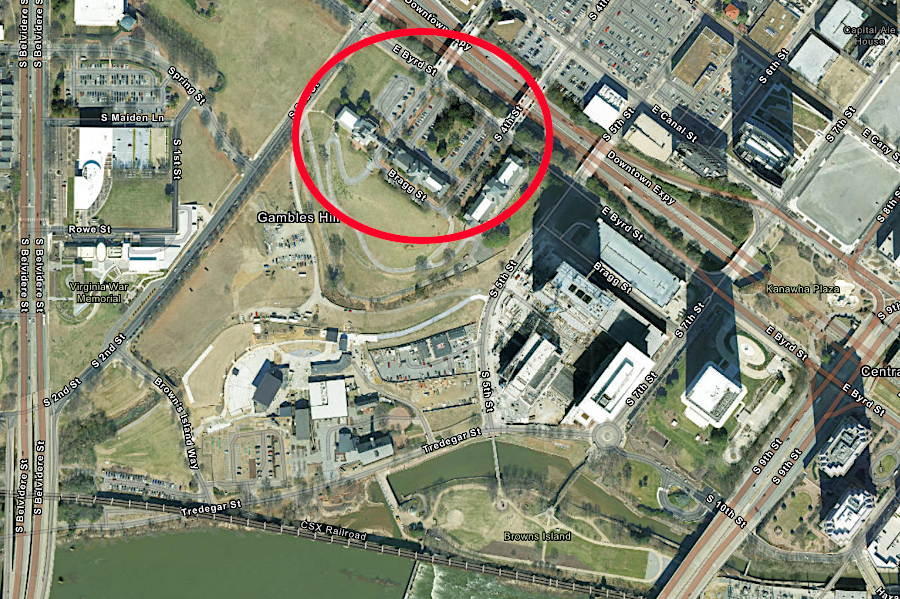
the site of the state penitentiary in Richmond was redeveloped into corporate headquarters for the Ethyl Corporation
Source: ESRI, ArcGIS Online