
in 1848, the Virginia and Tennessee Railroad was not completed southwest of Ingles Ferry (Radford) - and there was no city of Roanoke yet
Source: Library of Congress, A map of the internal improvements of Virginia (Claudius Crozet, 1848)
in 1848, the Virginia and Tennessee Railroad was not completed southwest of Ingles Ferry (Radford) - and there was no city of Roanoke yet
Source: Library of Congress, A map of the internal improvements of Virginia (Claudius Crozet, 1848)
The Virginia & Tennessee Railroad started as the Lynchburg and Tennessee Railroad Company in 1848. It was chartered in 1849 to connect Lynchburg with Bristol, on the Tennessee border. It used the Roanoke River water gap to cross the Blue Ridge, but required five tunnels and 233 bridges along the route. The longest bridge was over the New River, where a 700' covered bridge was constructed.
Construction of 204 miles of 5' gauge railroad, plus a spur over nine miles long to Saltville, was completed in 1856. The construction crew consisted of Irish laborers and enslaved workers hired by the railroad. A roundhouse and repair shops built at Central Depot in 1854 evolved into the City of Radford. Foundry operations there depended upon the railroad to transport complete iron pipe and other products to market.1
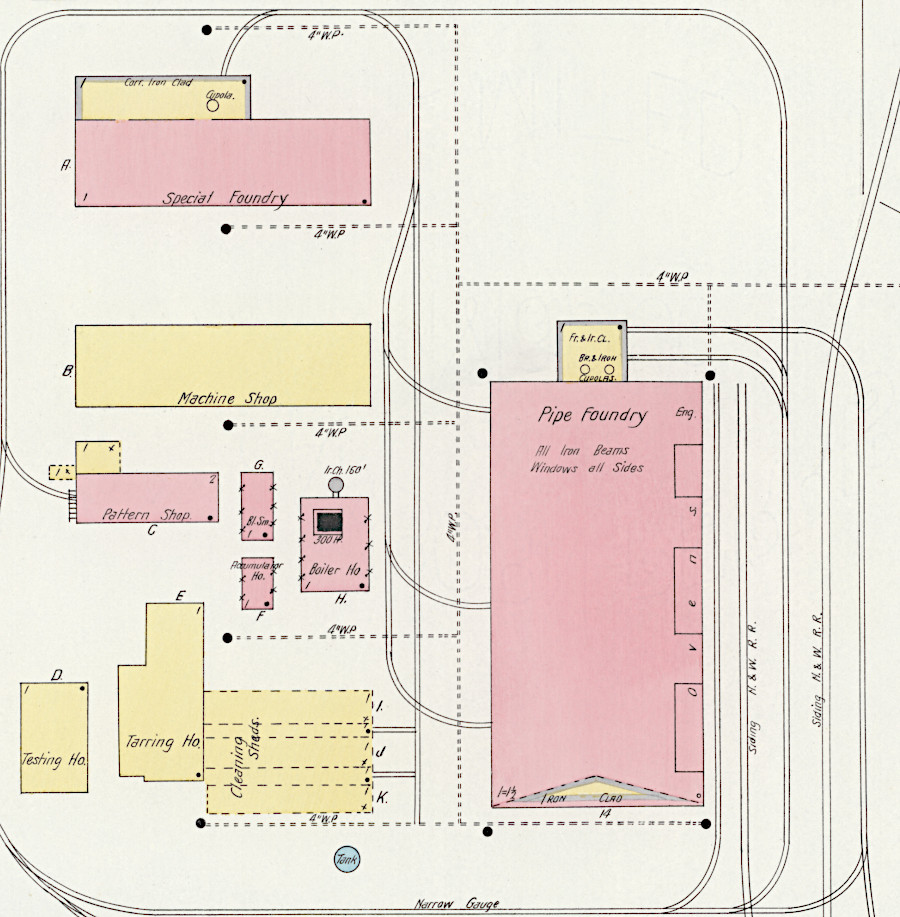
the major industry at Radford was a foundry, which depended upon the railroad to transport pipe and other products
Source: Library of Congress, Sanborn Fire Insurance Map from Radford, Independent Cities, Virginia (1896)
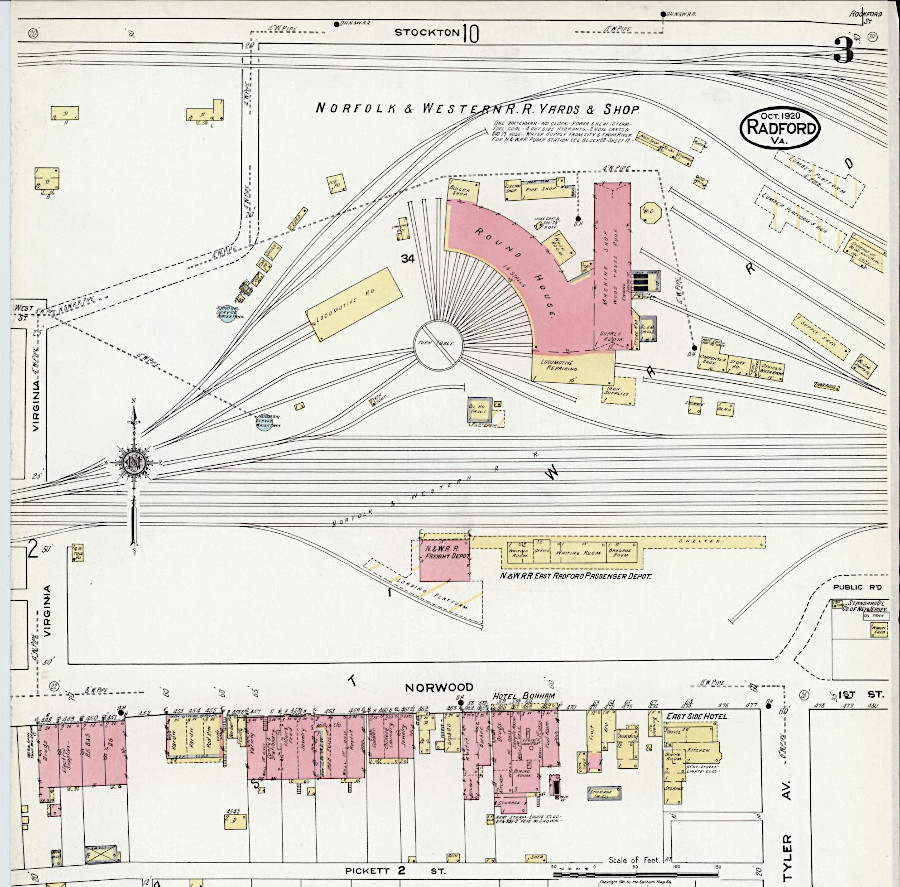
the site of the Norfolk and Western Railroad roundhouse in Radford is still part of the railyard
Source: Library of Congress, Sanborn Fire Insurance Map from Radford, Independent Cities, Virginia (1920)
The Virginia & Tennessee Railroad linked Tennessee to the Chesapeake Bay prior to the Civil War. On the eastern end, the Virginia & Tennessee Railroad connected in Lynchburg with the South Side Railroad. On the western end, the East Tennessee and Georgia Railroad. That track was built north from Knoxville and connected at Bristol in 1858.
Private investors desired regular dividends, so they were reluctant to construct high-quality track and trestles or to upgrade the quality of the rail, locomotives, and cars. With government funding in this public-private partnership, the Virginia and Tennessee Railroad laid its rails and ies in rock ballast rather than directly on the ground.
In 1860, the Commonwealth of Virginia's Bureau of Public Works owned 28,000 of the 35,402 shares outstanding.2

the Virginia and Tennessee built a tunnel at the western edge of Lynchburg
Source: Library of Congress, Map & profile of the Virginia & Tennessee Rail Road (William Willis Blackford, 1856)

the Virginia & Tennessee Railroad had to cross Alleghany Mountain between Salem and Christiansburg
Source: Library of Congress, Map & profile of the Virginia & Tennessee Rail Road (1848)
The economic connection led to an expansion of slavery in that region west of the Blue Ridge, and shaped the location of the boundary of West Virginia in 1863.
After the Civil War, the Virginia & Tennessee Railroad interchanged traffic with the Orange and Alexandria Railroad at Lynchburg. As a result, trains went north to Alexandria and increased business at that port city.
Virginia's provisional governor during Reconstruction, Henry C. Wells, planned to sell the Virginia Board of Public Works investment in the Virginia & Tennessee Railroad to the Baltimore and Ohio (B&O) Railroad. The Baltimore and Ohio Railroad already had gained control of the Orange and Alexandria Railroad and the Washington, Alexandria and Georgetown Railroad, which connected the B&O depot in the District of Columbia to Alexandria via the Long Bridge. Control of the Virginia & Tennessee Railroad would give the Baltimore and Ohio Railroad a trunk line through Virginia.
The Baltimore and Ohio Railroad was allied with Virginia Governor Francis Pierpont, and then provisional governor Henry C. Wells. In 1866 the General Assembly chartered the Valley Railroad, which the B&O would finance to build track from Harrisonburg south to Salem. The plan was to divert traffic coming north from Bristol to Baltimore. There was potential for the Baltimore and Ohio Railroad to acquire more railroads and extend its network deep into Georgia and Alabama, allowing the B&O to gain a large share of the market for transportation of Southern cotton to mills in the northeastern states.
William Mahone, president of the Norfolk and Petersburg Railroad, wanted the traffic on the Virginia & Tennessee Railroad to go east to Norfolk, where cotton could be sent via steamship to northern mills and Europe. Mahone first gained control of the South Side Railroad. In 1869, he successfully supported Gilbert C. Walker in his campaign for governor against Henry C. Wells. After his election, Governor Walker approved the sale of Virginia's shares in the Virginia & Tennessee Railroad to Mahone.
In 1870, Mahone completed the merger of the three railroads. The Norfolk and Petersburg Railroad, South Side Railroad, and Virginia & Tennessee Railroad were combined to create the Atlantic Mississippi & Ohio Railroad. That created a single line which connected Bristol to Norfolk.3
The Atlantic Mississippi & Ohio Railroad went bankrupt in 1876, after the Panic of 1873. Later mergers incorporated the original Virginia and Tennessee Railroad into the Norfolk and Western Railroad and then into today's Norfolk Southern Railroad. The route is in active use, though minor relocations have lowered grades, straightened curves, and improved stream crossings. For example, west of Forest in Bedford County a new track was built just north of the original roadbed, which has been converted into Elkton Farm Road.4

Elkton Farm Road in Bedford County uses the original roadbed of the Virginia and Tennessee Railroad
Source: ESRI, ArcGIS Online

by 1860, slavery was common west of the Blue Ridge along the route of the Virginia and Tennessee Railroad
Source: Library of Congress, Map of Virginia Showing the Distribution of its Slave Population from the Census of 1860 (by Henry S. Graham, 1861)
both private investors and the state of Virginia financed construction of the Virginia and Tennessee Railroad, which was completed in 1856
Source: Wikipedia, Virginia and Tennessee Railroad