
the City of Suffolk owns garbage cans
the City of Suffolk owns garbage cans
In 1976, eight jurisdictions in southern Hampton Roads created the Southeastern Public Service Authority (SPSA). It evolved from the Southeastern Water Authority of Virginia. That authority had been created originally in 1973, but failed to gain traction as a regional solution for coordinating water supply efforts.
The cities of Norfolk, Chesapeake, Suffolk, Portsmouth, Virginia Beach, Franklin and the counties of Southampton and Isle of Wight were more successful in creation a regional solution to manage municipal solid waste. Between 1979-1984, they signed 30-year contracts to manage 95% of their waste. In 1982, the Southeastern Public Service Authority purchased 308 acres in Suffolk and constructed a single landfill to accept waste from all partners.
The commitment to provide 95% rather than 100% of the waste to the regional authority gave flexibility to the eight jurisdictions. Virginia Beach chose to continue to accept household waste at its second landfill, known now as the Landfill & Resource Recovery Center. The city's first landfill was closed in 1971 and converted into a park called Mount Trashmore.
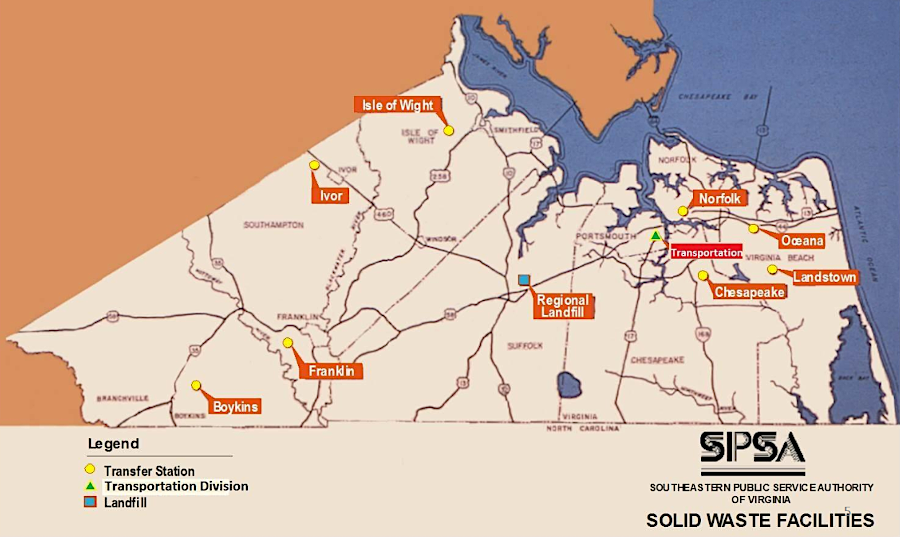
in 2019, trash was collected at these waste transfer stations abd then trucked to the regional landfill in Suffolk
Source: City of Portsmouth, Southeastern Public Service Authority (SPSA) - Overview and
Highlights
Two waste management approaches were adopted, incineration and landfill disposal.
In 1980 the US Navy built a new steam generating plant in Portsmouth for the Norfolk Naval Shipyard. It transferred ownership of the plant in 1999 to the Southeastern Public Service Authority. In 2010, the authority sold the plant to Wheelabrator Technologies. That company processed the waste at a Refuse Derived Fuel (RDF) building and sent it via conveyor belt to a Waste-to-Energy (WTE) plant next door. The fuel was incinerated there to create electricity and steam.
Over 80% of the municipal solid waste from the eight members of the regional waste authority was delivered to Wheelabrator facility. Electricity was fed to the Norfolk Naval Shipyard, with excess going into the transmission grid. Steam was delivered to the adjacent shipyard. Ash from incinerated waste was sent to the regional landfill for disposal.

the Wheelabrator plant in Portsmouth was on the northern edge of the Norfolk Navy Shipyard
Source: ESRI, ArcGIS Online
Revenue from the US Navy for steam purchases, plus sale of electricity from the Wheelabrator plant, minimized solid waste disposal costs for the eight jurisdictions in the regional agency.1
The contract with Wheelabrator Technologies was scheduled for renewal in 2018. In 2016, the Southeastern Public Service Authority signed a contract with RePower South to separate out recyclables in the municipal solid waste and process remaining paper and plastic into fuel pellets. The pellets would be burned along with coal at electricity generating power plants or cement kilns. The company planned to build a $100 million mixed waste processing facility in the City of Chesapeake.
The cost to process 350,000 tons of waste annually for 15 years was projected to be half the current tipping fee at the landfill. However, after RePower was unable to negotiate a contract for Dominion Energy to purchase pellets, the regional waste authority cancelled the proposed 15-year RePower contract in 2017. A new contract with Wheelabrator Technologies was signed for operations through 2027, with the potential for up to 10 years of extensions.2
The US Navy completed an Environmental Assessment in 2017 of a plan to build its own 20 MW (megawatt) Combined Heat and Power Plant at the Norfolk Naval Shipyard. it was designed with two turbines burning natural gas, with Ultra Low Sulfur Diesel (ULSD) as back-up for up to 1,000 hours per year, rather than Refuse Derived Fuel.
Lowering costs for steam and electricity would free up funding to construct at new Industrial Wastewater Treatment Plant, replacing a 40-year old facility. The power plant and a Battery Energy Storage System was planned to serve as an independent source of electricity in case the electricity transmission grid was interrupted, enhancing national security.3

the new US Navy Combined Heat and Power Plant was built on a parking lot at the shipyard
Source: Norfolk Naval Shipyard, Combined Heat and Power Plant and Energy Conservation Measures Briefing (July 1, 2020)
A 2022 fire cut in half the capacity of the Refuse Derived Fuel (RDF) plant, which was operated by Wheelabrator. The Southeastern Public Service Authority compensated by taking more municipal solid waste to the regional landfill in Suffolk. When the US Navy pulled out of the contract, Wheelabrator decided to close the facility on June 30, 2024 and tear it down in 2026.
Loss of the incineration option required landfilling all of the waste. The Southeastern Public Service Authority determined that the regional landfill would reach its permitted capacity in 2060, but 70% of the material being disposed at the landfill could be recycled or converted into biochar. The regional agency then chose to pursue a Alternative Waste Disposal project using cameras, robotics, and artificial intelligence (AI) technology to separate material which could be diverted from the landfill.
RePower bid on the contract, and the Southeastern Public Service Authority visited its facilities in Berkeley County, South Carolina and Baltimore, Maryland. The regional agency chose to award the contract to Commonwealth Sortation, a subsidy of AMP Sortation. That company provided the detailed financial data as requested, and the evaluators determined its "proposed technology to be less complex, more robust, more reliable."
A pilot project in Portsmouth by that company demonstrated that it could extract and recycle over 50% of the municipal solid waste it received. Hampton Roads jurisdictions saw the opportunity to eliminate the extra costs to collect recyclable material in separate bins while still achieving recycling goals.
Increasing recycling and separating compost was expected to extend the life of the landfill through the 21st century. The new artificial intelligence sorting process would limit future rate increases; hauling waste to a new landfill outside of Hampton Roads would double the costs to the members of the Southeastern Public Service Authority.

the Southeastern Public Service Authority became the regional waste manager in 1976
Source: Southeastern Public Service Authority (SPSA), Our Story
The City of Chesapeake had already ended its curbside recycling program in 2022. Jurisdictions planned to send separate collection of recyclables once existing contracts for household waste collection expired. The City of Suffolk told residents that they could put trash and recyclables together starting July 1, 2026; no longer would they need to be kept separate in the blue and green bins.
The private company raised capital and invested $200 million in the "largest recycling project in the United States." The new plant started initial operations in 2026. By 2029, Commonwealth Sortation expected to process 500,000 tons a year and extend the life of the landfill through 2095.4
Once cities in south Hampton Roads switched to SPSA Waste Solutions' new one bin system, they no longer needed to contract with TFC Recycling to continue the separate collection of blue bins with metal, paper, and #1 and #2 plastics.
TFC Recycling, which used similar technology to sort items from blue bins, created a petition campaign in the City of Suffolk hoping to get their collection contract renewed. As a selling point, the company highlighted that separation of recyclables by customers produced cleaner materials than mixing wastes into one container.5
Source: SPSA Waste Solutions, What is Alternative Waste Disposal?
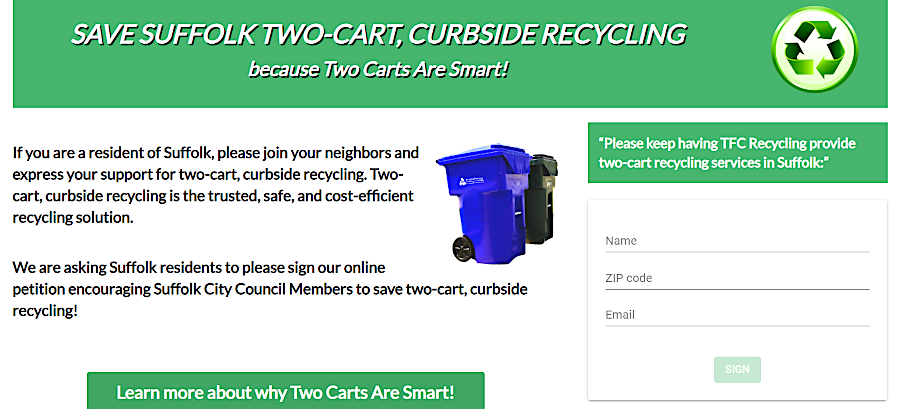
TFC Recycling sought to retain its contract with Suffolk for collecting recyclables in a separate blue bin, after SPSA Waste Solutions contracted for collecting mixed solid waste from one bin at each house
Source: TFC Recycling
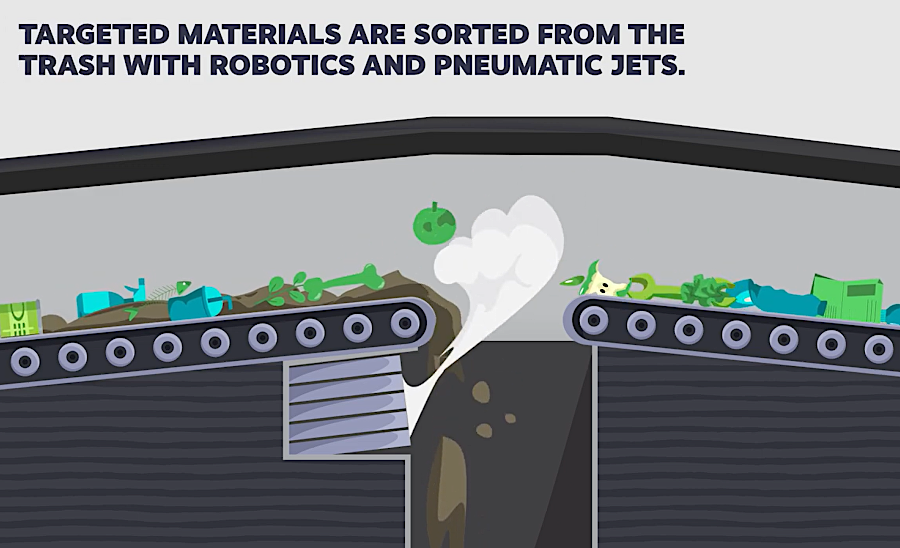
at the Alternative Waste Disposal project, artificial intelligence (AI) helped identify how to sort recyclables and materials suitable for biochar from waste destined for the landfill
Source: SPSA Waste Solutions, What is Alternative Waste Disposal?
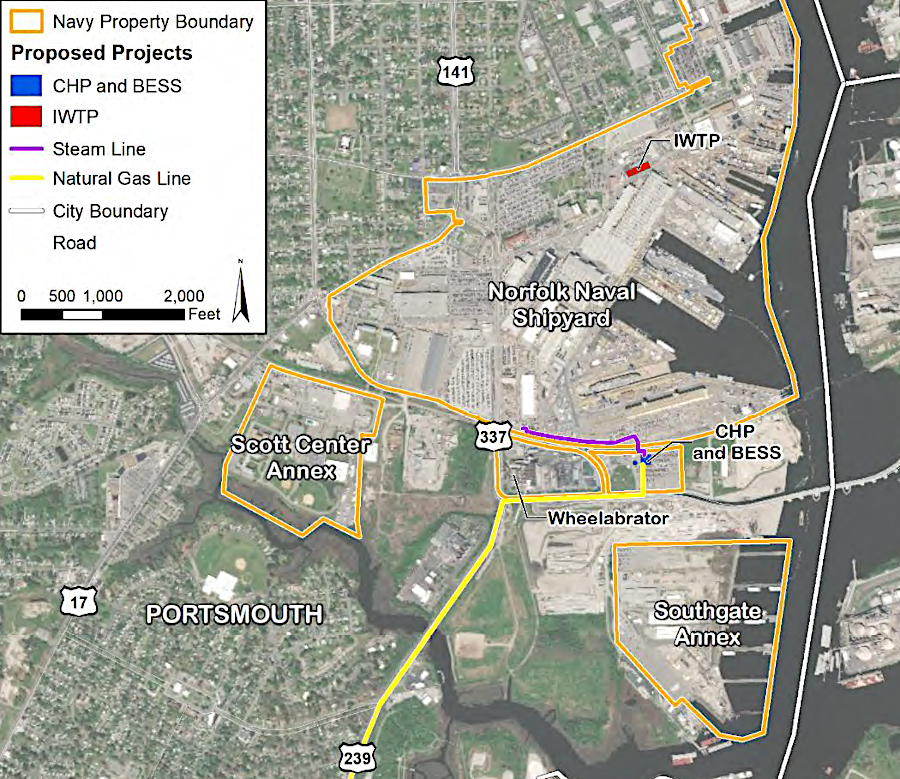
the Wheelabrator plant was replaced with a Combined Heat and Power Plant (CHP) fueled by natural gas and a Battery Energy Storage System (BESS)
Source: Norfolk Naval Shipyard, Environmental Assessment for Implementation Of Energy Conservation Measures (Figure 2.1-2)